At least five organisations, one dojo, one club tool.
Kyokushin has no Swiss governing body. Five and more mutually independent organisations, each attached to its own international parent — no shared licence, no shared ranking, no shared dan register. Paak is the club layer that absorbs that fragmentation instead of pretending it away.
- Dual affiliation is normal here — Kyokushinkai Karate Club Winterthur sits in the IFK-Switzerland directory and the Kyokushin Karate Union Schweiz directory at the same time
- J+S without joining a federation first — karate has been a Jugend+Sport sport since 1995, and the recognition names no style
- LEICHT / MITTEL / SCHWER inside the age band — the Kyokushin logic for juniors, not a kilo grid borrowed from another karate
Free up to 100 members. Live in Switzerland · CHF, TWINT.
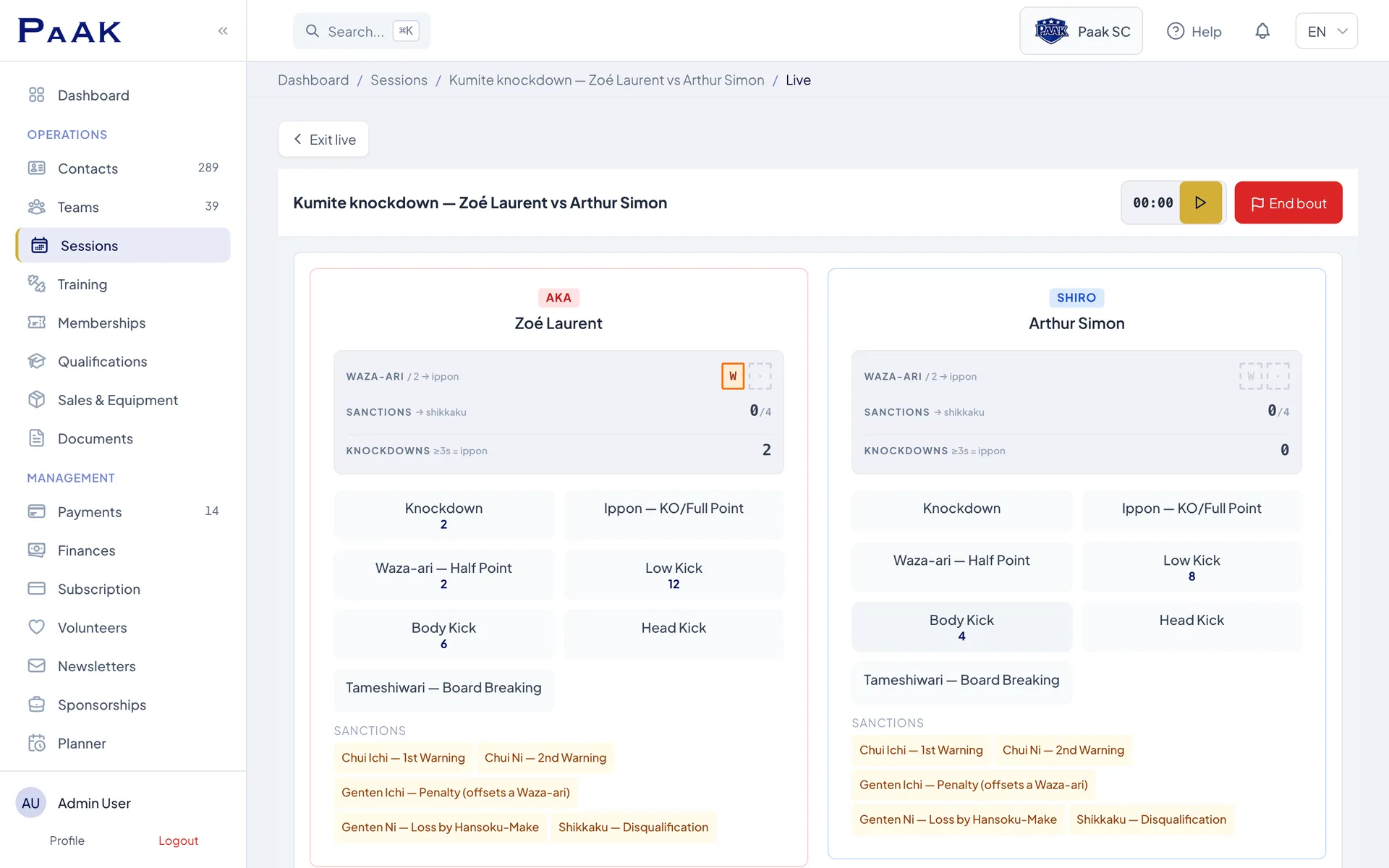

Scattered across the country, joined up in the dojo.
Less admin, more kyokushin.
While you are in the dojo, the club keeps running: members register online from your club’s public page, pay their fees and sign their waivers — and everything lands in your dashboard, with nothing to re-type.
Included from the free plan — public page and member portal on every tier.
- Online registration from your club’s public page — no more paper forms
- Fees by card or SEPA direct debit, in one or several instalments per your plans
- Waivers and image-rights consent signed online, timestamped
- A member portal with no account, no password: schedule, payments, documents
- Automatic reminders and follow-ups — fees, licences, certificates
- One-tap roll call, attendance tracked session after session
There is no Swiss Kyokushin federation — and that is not an oversight.
Kyokushin has no national governing body in Switzerland. No Kyokushin organisation is a Swiss Olympic member: the 2024 federation survey contains zero occurrences of "Kyokushin". The commercial register does not know one either — a Zefix search returns three entities, none of them a national federation.
What exists instead is five and more mutually independent, lineage-based organisations, each with its own international parent. Software that asks you to pick "your Swiss Kyokushin federation" from a dropdown has not checked.
What this page deliberately does not say: which organisation is "the leading" one. IFK-Switzerland is the largest by published dojo count — no stronger claim is available, because IKO-Switzerland and Swiss Kyokushinkai Karate publish no countable directory. The phrase "der führende Fachverband für Kyokushinkai Karate in der Schweiz" is a self-description, not a recognition, and is quoted here as such.
Grades, passports and competition stay with your lineage
- There is no Swiss-wide Kyokushin licence and no Swiss-wide ranking — each organisation runs its own
- IFK-Switzerland issues its own instruments: an IFK-Pass, an IFK-Membershipcard and Lizenzmarken, ordered through its own shop
- Dan grades, grading rules and the championship calendar belong to your international parent
- The IFK lineage dates itself: Swiss Kyokushinkai Karate Organisation (SKO) founded 7 January 1995, IFK Switzerland constituted 4 May 1996 — not to be confused with Swiss Kyokushinkai Karate (SKK) in Lucerne
What falls between the organisations
- Members, dues and camp fees in CHF through Mollie (incl. TWINT)
- Multiple affiliations per club and per person — training with one body, competing under another
- Attendance per session, coach qualifications with expiry dates, parent communication
- Club accounting, volunteering and the member portal for your members
Karate is a J+S sport — and the recognition names no style.
This is the most useful line on the page, and it runs the opposite way to what the fragmentation suggests: karate was admitted as a J+S sport in 1995, and the recognition carries no style restriction at all.
What follows
A Swiss Kyokushin dojo can run J+S courses and camps with J+S-qualified leaders without belonging to the Swiss Karate Federation.
What Paak keeps
Attendance per session and per camp, participant lists, coach qualifications with expiry dates, reminders at 30 / 14 / 7 days, one-click CSV export.
What Paak is not
Not a J+S registration platform. Paak replaces neither the official J+S instruments nor your organisation's own — it keeps the records you have to keep anyway.
What this page deliberately does not say: that any Kyokushin organisation holds J+S partner status in its own right. That is not verified. Confirm your route into J+S with the body that approves your courses — Paak will not hand you a status nobody has documented.
For juniors it is LEICHT, MITTEL, SCHWER — not the kilo.
From the officially published results of the 2025 IFK Kumite Swiss Championship: 19 categories were actually contested. Juniors are banded by birth year and then by LEICHT / MITTEL / SCHWER (light / middle / heavy) — not by kg cut-offs. Software that pre-fills the WKF grid invents categories your dojo does not have.
Women's lightweight
up to 60 kg
Men's lightweight
up to 70 kg
Men's middleweight
70–80 kg
Women's Open
no weight limit
Men's Open
no weight limit
Source is dated: the bands above are the age bands itemised in the source, not the full list of 19 categories. This Elite regulation is in force from 01-2016 — check the current state with your organisation. No women's middleweight cut-off is published there, and Paak invents none: you enter the categories your organisation actually runs.
Children do not fight knockdown. Kyokushin Karate Union Schweiz states that children and youth of J+S age "fight without contact or with light contact", the aim being "not the knockdown" but the execution of the technique. In Paak the category and the grade are recorded per member on the athlete profile — your organisation's Elite rule is never applied automatically to the youngest bands.
From 6th kyu — the rest is paperwork.
"In principle one may only fight from 6th kyu; exceptions are decided by the technical commission." Full contact adds its own obligations: a doctor must be present at tournaments, and minors need a parental competition permission (Wettkampferlaubnis) plus medical clearance. Paak keeps those records per person, with dates and expiry.
- Kyu grade per karateka — the grade sits on the athlete profile, so you can check the 6th-kyu threshold yourself before entering anyone. Exceptions are entered by hand, because the technical commission decides them, not the software
- Parental permission and medical clearance as dated documents on every under-age member
- Reminders at 30 / 14 / 7 days before expiry, one-click CSV export
- Two affiliations on the same person — the reality of a country with no shared register
Paak issues no clearance and replaces no medical judgement. It records what exists and flags what is missing.
Your members get their own space — no account, no password.
A personal secure link in every club email: schedule and call-ups, dues payable online (“Pay everything” in one payment), medical certificate upload, progression, volunteering.
Simple, transparent pricing
Start free. Upgrade when your club grows. One price, for every club.
- Up to 100 members
- 3 admins, 1 sport, 3 groups
- Member management & CSV import
- Households, emergency contacts & family discounts
- Sessions & attendance with RSVP
- Collect membership fees online — 1.2% fee (capped at CHF 2.50)
- Session plan on the session — minuted blocks, editable
- Emails to members — 50 per month
- Emergency protocols & incidents
- Sponsorship (3 max)
- Staff background-check tracking (automated follow-ups)
- Data hosted in Europe (EU), nLPD adequacy recognised
- Member portal for every member — no account, no password
- Public club page — your web presence, in your colors, with registration built in
- Everything in Free, plus:
- 500 members, 5 admins (+CHF 3/seat/mo)
- 3 sports, 10 groups
- Automated payment reminders
- Club-branded emails
- Sponsorship management + sponsor benefits
- Email support
- Sales & equipment (passes, gear)
- Background-check tracking: federation CSV export + auto reminders
- Club newsletter + member emails — 300/mo
- Automated season rollover
- Accounting: income & expense journal + CSV export
- Member documents (medical certificate) — encrypted upload + review
- Printable session sheet + unlimited club-authored drills
- Public page: choose which sections show (fees, teams, venues…)
- 0% Paak fee on online collections
14-day free trial included
- Everything in Paak One, plus:
- Unlimited members
- 10 admin users (+CHF 5/seat/mo)
- Unlimited sports & groups
- Advanced analytics & exports
- Live performance tracking
- Training analytics: planned vs delivered
- Sponsorship ROI & auto-renewal
- Priority support
- Advanced newsletter (rich editor, templates, analytics, 5,000/mo)
- Newsletter merge fields (12 variables)
- AGM financial report · budget · bank reconciliation · XLSX export
14-day free trial included
Prices incl. Swiss VAT (8.1% MWST).
Accepted payment methods
Frequently asked questions
Are there ready-made training sessions?
Yes. Pick an age band and a theme (kihon, kicking techniques, kata, preparatory kumite, physical) and Paak builds a minuted session — warm-up, two mains, a kumite game form — from 30 drills sourced from the organisations' published syllabi (IKO, IFK/IKKU, WKO/EKO rules): exactly the same ones as in the Côté Coach guide at paak.club/en/training/kyokushin/. The contact gates are in the data: no knockdown drill exists for under-9s. Planning, editing and saving the session is free; printing the sheet is in Paak One.
Which Swiss Kyokushin federation is Paak affiliated with?
None — there isn't one. Kyokushin has no national governing body in Switzerland, and no Kyokushin organisation is a Swiss Olympic member: the 2024 federation survey contains zero occurrences of "Kyokushin". Paak is club software, not a federation. The exam sheet's criteria and scale are configurable per dojo, and weight categories are chosen from the organisations' official grids (IKO, WKO Shinkyokushinkai, IFK, KWF…).
Our dojo appears in two directories. Does that break anything?
No, and it is not an edge case: Kyokushinkai Karate Club Winterthur appears in the IFK-Switzerland directory and in the Kyokushin Karate Union Schweiz directory at the same time. Paak models multiple affiliations per club and per person instead of forcing a single one.
Do we need the Swiss Karate Federation in order to run J+S?
No. Karate has been a J+S sport since 1995, and the recognition names no style restriction. A Kyokushin dojo can run J+S courses and camps with J+S-qualified leaders without belonging to the Swiss Karate Federation. Whether any Kyokushin organisation holds J+S partner status in its own right is not verified, and is therefore not claimed here.
Are the Kyokushin categories supported — rather than the WKF grid?
Yes. Juniors by birth-year band and then by LEICHT / MITTEL / SCHWER (light / middle / heavy), as at the 2025 IFK Kumite Swiss Championship where 19 categories were actually contested. Elite per the regulation in force from 01-2016: women's lightweight up to 60 kg, men's lightweight up to 70 kg, men's middleweight 70–80 kg, women's Open, men's Open.
How many Kyokushin dojos are there in Switzerland?
Nobody knows exactly, and Paak does not estimate. IFK-Switzerland publishes 19 dojos (11 full members, 8 guest members), Kyokushin Karate Union Schweiz three, Swiss Kyokushin-Kan Karate Organization three Garyu dojos. IKO-Switzerland and Swiss Kyokushinkai Karate publish no count at all. As a sense of the competitive circuit: the 2025 IFK Kumite Swiss Championship drew 80 fighters from 16 dojos from across Switzerland, across 88 bouts.
Do the children fight knockdown?
Not at Kyokushin Karate Union Schweiz: children and youth of J+S age "fight without contact or with light contact", the aim being "not the knockdown" but the execution of the technique. In Paak the category and the grade are recorded per member on the athlete profile — your organisation's Elite rule is never applied automatically to the youngest bands.
Can Paak handle belt gradings?
Yes. Create a "Grading" session: the candidate list comes from the roll-call, and the exam sheet prints with your club's own criteria and scale (session and sheet available on every plan). From Paak One, each candidate is pre-filled to the next grade and one click updates every successful candidate's grade, with per-member history — previous grade, date, examiner.
Your dojo, connected in 30 seconds.
Dual affiliation, Kyokushin categories, competition clearances, dues in CHF — without assuming a governing body that does not exist. Free up to 100 members.
OSU!