Kyokushin, the hardest style of karate.
The full-contact style born from Mas Oyama: no chest protection, scoring by knockdown. Paak encodes it as a discipline distinct from WKF karate: its rules, its scoring, its grades, its own severity.
- Knockdown scoring: ippon, waza-ari, hantei, tameshiwari (counts, not a WKF arithmetic score)
- Tameshiwari & grades: personal board-breaking record, 10 kyu + dan in Kyokushin's own order
- Child-protection compliance: federation licences, instructor checks, reminders before expiry
Free up to 100 members. No credit card. 30-second setup.

A karate apart, encoded as such.
The fight is won by knockdown, not points.
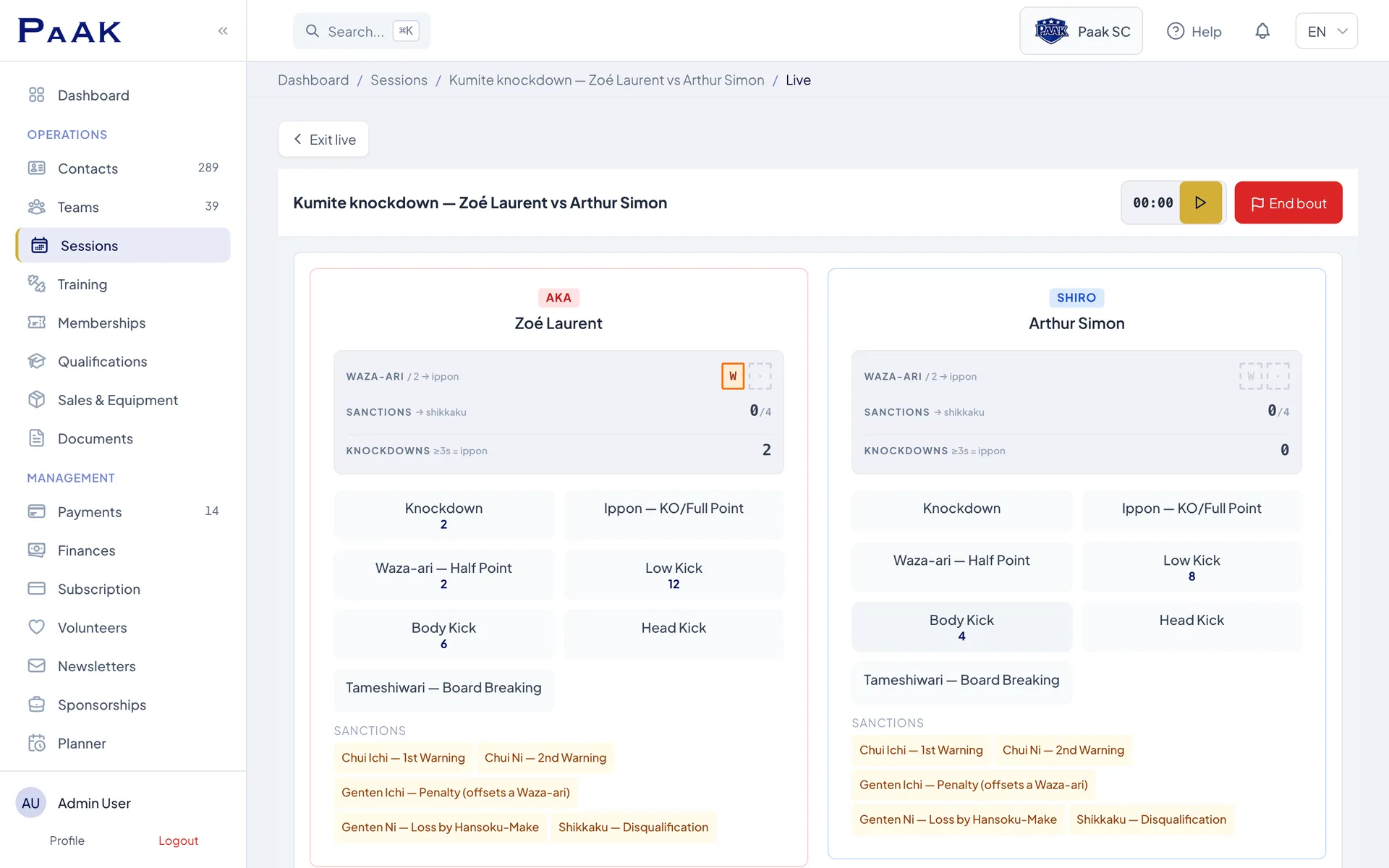
Kyokushin Knockdown isn't won on cumulative points: it's won by ippon, two waza-ari, hantei (judges' decision) or shikkaku. Paak records the counts (waza-ari, knockdowns and sanctions), not an arithmetic score. The live tracker is part of Paak Pro.
- Counts, not arithmetic: waza-ari, knockdowns and sanctions per fighter
- Counted strikes: low kick, body kick, head kick (Kyokushin's full-power techniques), per fighter
- Encho-sen: extensions then weight difference; a bout must have a winner
Board breaking, a stat in its own right.
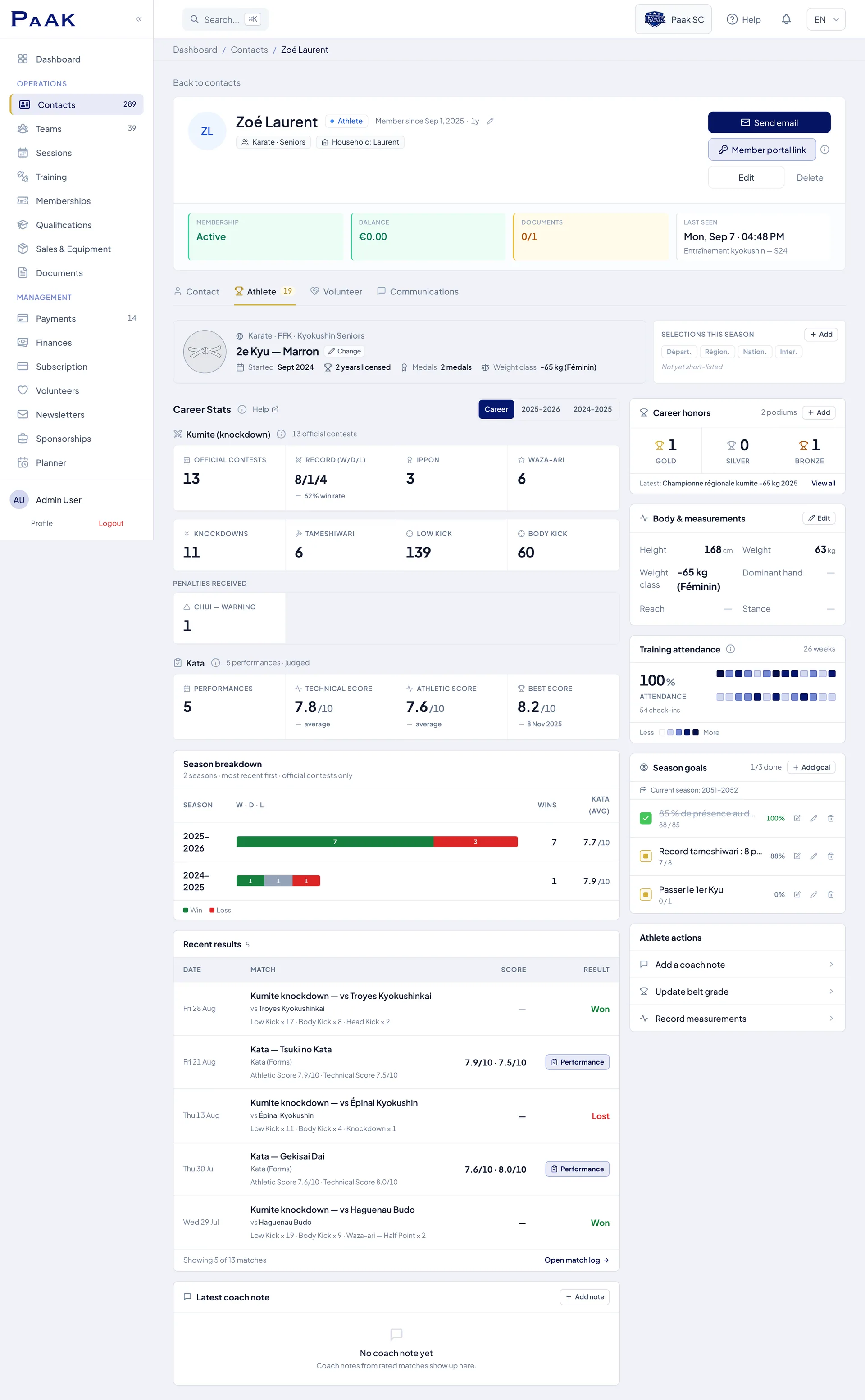
In no other amateur combat sport do you break boards bare-handed before competing. Each karateka has a personal tameshiwari record, the number of boards broken, stored on their profile alongside kyu, rounds and kata.
- Tameshiwari record: the personal board-breaking record, in boards
- Kyu, fights, kata scores: the full progression on a single profile
- Knockdown kumite counters: ippon, waza-ari, sanctions, aggregated season by season
Less admin, more kyokushin.
While you are in the dojo, the club keeps running: members register online from your club’s public page, pay their fees and sign their waivers, and everything lands in your dashboard, with nothing to re-type.
Included from the free plan: public page and member portal on every tier.
- Online registration from your club’s public page, no more paper forms
- Fees by card or SEPA direct debit, in one or several instalments per your plans
- Waivers and image-rights consent signed online, timestamped
- A member portal with no account, no password: schedule, payments, documents
- Automatic reminders and follow-ups: fees, licences, certificates
- One-tap roll call, attendance tracked session after session
Knockdown scoring, in Kyokushin's own terms.
No arithmetic score: exactly the counts and criteria of Kyokushin Knockdown. The fight is won by ippon, two waza-ari, hantei or shikkaku.
Kyokushin, a karate different in its rules.
Mas Oyama founded Kyokushin in 1964. Multi-sport software that configures it as WKF karate pre-ticks boxes that make no sense. Paak separates the two, because the rules demand it.
Full-contact, not on points
In the WKF, a controlled strike scores a point. In Kyokushin, a strike is valid when it removes the opponent from the fight. Knockdowns, waza-ari, low kicks: a different scale.
Tameshiwari, not choreography
Breaking boards bare-handed is a stat in its own right in Kyokushin. Paak tracks it as such, personal record included.
Kyu / dan, not WKF colours
White (Mukyu), then 10 kyu from orange to brown, then dan. Grading criteria vary between IKO, WKO Shinkyokushin, KWF, each with its own tameshiwari, kumite and kata demands.
Encho-sen, a winner required
No clear winner? An extension (encho-sen), then a second, then weight difference decides. In Kyokushin, a draw is the exception.
10 kyu, the dan, and the weight categories.
An order of Kyokushin's own, distinct from WKF karate's FFK order: white (Mukyu), orange (10th-9th kyu), blue (8th-7th), yellow (6th-5th), green (4th-3rd), brown (2nd-1st), then 10 dan from black.
Weight categories chosen from the organisations' official grids (IKO, WKO Shinkyokushinkai, IFK, KWF…): men -60 / -70 / -80 / -90 / +90 kg · women -50 / -55 / -65 / +65 kg · juniors (-18) adjusted by age · veterans (+40) often the same as seniors, with a shorter bout. Paak checks the recorded weight and places each karateka in the right category.
Men
-60 · -70 · -80 · -90 · +90 kg
Women
-50 · -55 · -65 · +65 kg
Juniors (-18)
Adjusted by age, per the official grid
Veterans (+40)
Seniors, shorter bout
Instructor checks, tracked for you.
Full-contact adds obligations: medical certificates, federation licences, child-protection checks for anyone working with minors. Paak tracks every expiry and alerts before it lapses.
- Federation licences: number, validity, alongside your Kyokushin body (IKO, WKO Shinkyokushin, KWF; FFKDA in France)
- Child-protection checks: tracked with 30/14/7-day reminders (the 8 March 2024 law in France; the equivalent elsewhere)
- Medical certificates: required for full contact; expiry blocks competition entry
- Teaching qualifications: recorded with validity dates and renewal
Attendance at training, even offline.
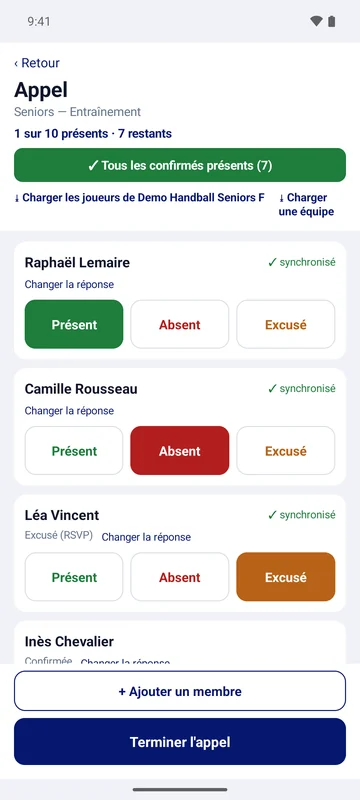
The Paak app for your coaches and club officers: offline attendance, a reminder before each session, the live match with Paak Pro. Included in every plan.

Your members get their own space, no account, no password.
A personal secure link in every club email: schedule and call-ups, dues payable online (“Pay everything” in one payment), medical certificate upload, progression, volunteering.
Simple, transparent pricing
Start free. Upgrade when your club grows. One price, for every club.
- Up to 100 members
- 3 admins, 1 sport, 3 groups
- Member management & CSV import
- Households, emergency contacts & family discounts
- 10 MB of file space
- Sessions & attendance with RSVP
- Collect membership fees online: 1.2% fee (capped at €2.50)
- Session plan on the session: minuted blocks, editable
- Club newsletter + member emails: 50 per month
- Emergency protocols & incidents
- Sponsorship (3 max)
- Staff safeguarding checks (legally required)
- EU-hosted data, built for GDPR
- Member portal for every member: no account, no password
- Public club page: your web presence, in your colors, with registration built in
- Everything in Free, plus:
- 500 members, 5 admins (+€3/seat/mo)
- 3 sports, 10 groups
- Automated payment reminders
- Club-branded emails
- Sponsorship management + sponsor benefits
- Email support
- Sales & equipment (passes, gear)
- Honorability: federation CSV export + auto reminders
- Club newsletter + member emails: 300/mo
- Automated season rollover
- Accounting: income & expense journal + CSV export
- Member documents (medical certificate): encrypted upload + review
- 500 MB of file space
- Printable session sheet + unlimited club-authored drills
- Public page: choose which sections show (fees, teams, venues…)
- 0% Paak fee on online collections
14-day free trial included
- Everything in Paak One, plus:
- Unlimited members
- 10 admin users (+€5/seat/mo)
- Unlimited sports & groups
- Advanced analytics & exports
- Live performance tracking
- Training analytics: planned vs delivered
- Sponsorship ROI & auto-renewal
- Priority support
- Advanced newsletter (rich editor, templates, analytics, 5,000/mo)
- Newsletter merge fields (12 variables)
- AGM financial report · budget · bank reconciliation · XLSX export
- 2 GB of file space
14-day free trial included
Prices shown are net (excl. VAT). VAT not applicable: service exported from Switzerland, reverse charge by the customer (art. 8 para. 1 LTVA).
Accepted payment methods
Frequently asked
Are there ready-made training sessions?
Yes. Pick an age band and a theme (kihon, kicking techniques, kata, preparatory kumite, physical) and Paak builds a minuted session (warm-up, two mains, a kumite game form) from 30 drills sourced from the organisations' published syllabi (IKO, IFK/IKKU, WKO/EKO rules): exactly the same ones as in the Côté Coach guide at paak.club/en/training/kyokushin/. The contact gates are in the data: no knockdown drill exists for under-9s, and every age gate is written into the coaching points with the organisation that imposes it. Planning, editing and saving the session is free; printing the sheet is in Paak One.
Why a page separate from WKF karate?
Because Kyokushin is full-contact, no chest protection, scored by knockdown, not on points like the WKF. Software that treats both the same produces wrong data for the coach.
Does Paak handle gradings with tameshiwari?
Yes. Create a "Grading" session: the candidate list comes from the roll-call, and the exam sheet prints with your dojo's own criteria (rename them freely, e.g. Kata, Kumite, Tameshiwari) and your scale (session and sheet available on every plan). The grade, date and examiner are recorded in each member's history; from Paak One, each candidate is pre-filled to the next grade and one click updates every successful candidate's grade.
My dojo is IKO Matsui, yours is WKO Shinkyokushin. Does Paak work for both?
Yes. The exam sheet's criteria are configurable per dojo: rename them (Kata, Kumite, Tameshiwari…), pick the scale (/10, /20, /100…) and save them as your club template. Weight categories are chosen from the organisations' official grids (IKO, WKO Shinkyokushinkai, IFK, KWF…). For a French dojo, kyu grades follow the Kyokushin colours and are awarded by the club teacher (the FFK publishes no Kyokushin kyu ladder); dan grades are awarded by the FFK dan commission (CSDGE). If your dojo follows its organisation's grades, adapt the list and say who defines it: the official list stays available.
Is it really free?
Yes, up to 100 members. Online payments included (Mollie). No credit card to sign up.
Your Kyokushin dojo, connected in 30 seconds.
Knockdown scoring, tameshiwari, kyu/dan, federation licences, safeguarding: it's all ready. Free up to 100 members, no credit card.
OSU!