Rugby Union and Rugby Sevens are not the same sport.
They share an oval ball, and that's about it. Paak already manages your members, payments, teams and compliance. For rugby, it goes further: XV and Sevens treated as two distinct disciplines (different statistics, different sanctions, different match lengths), and federation licences.
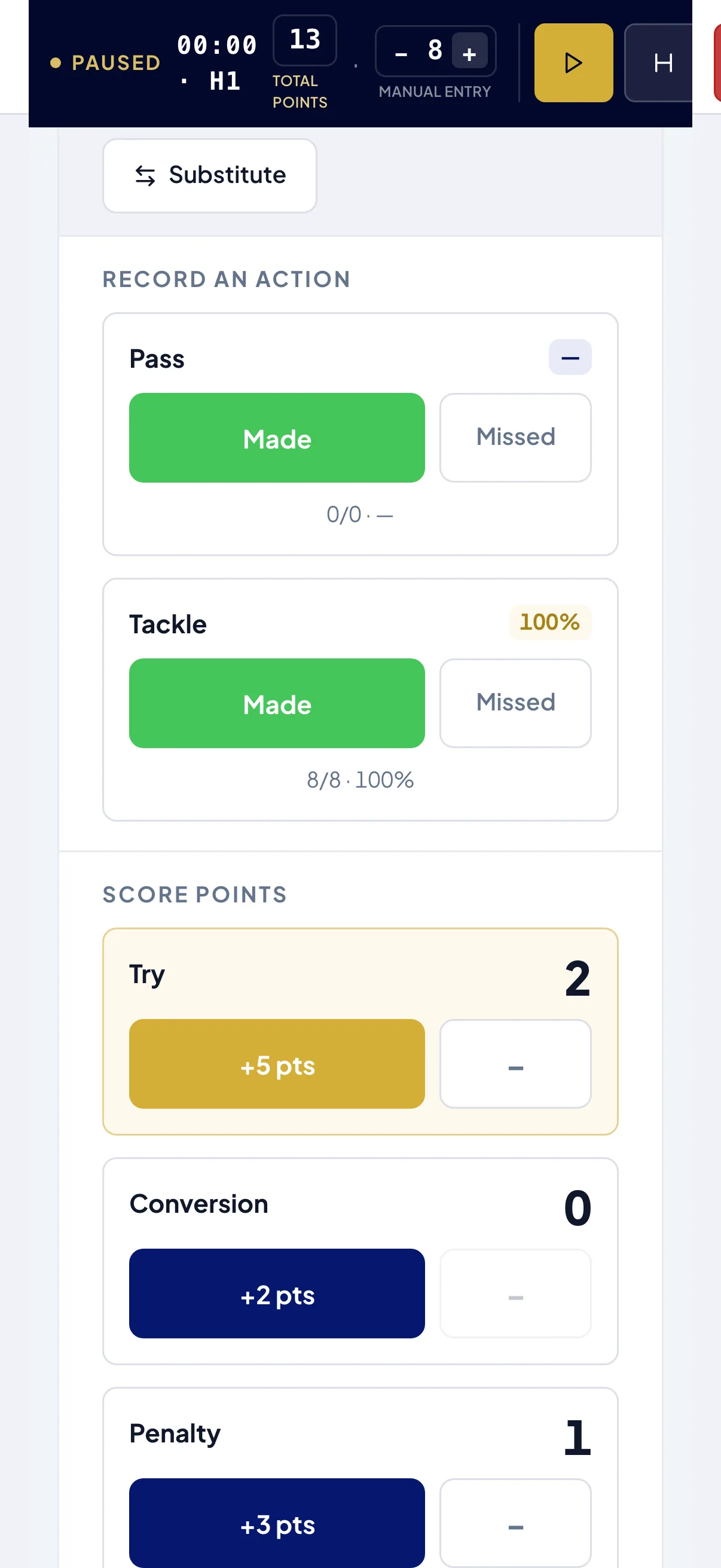
- XV vs Sevens: the tracker swaps its stat buttons by active discipline
- Per-discipline sanctions: yellow card 10 min in XV, 2 min in Sevens, applied automatically
- Federation licences & qualifications: tracked with automatic expiry alerts
Free up to 100 members. No credit card. Setup in 30 seconds.
Everything a rugby club manages, in one tool.
XV and Sevens, two separate configurations.
Not a "number of players" dropdown. The tracker swaps its stat buttons by active discipline, the match clock follows the regulatory duration, sanctions apply the right exclusion length.
- XV mode: 11 stats, 4 sanctions, numbered positions 1-23
- Sevens mode: 8 stats, 3 sanctions, 7 positions configured
- Yellow card 10 min XV / 2 min Sevens: the difference is enormous on a short match, Paak applies the right duration
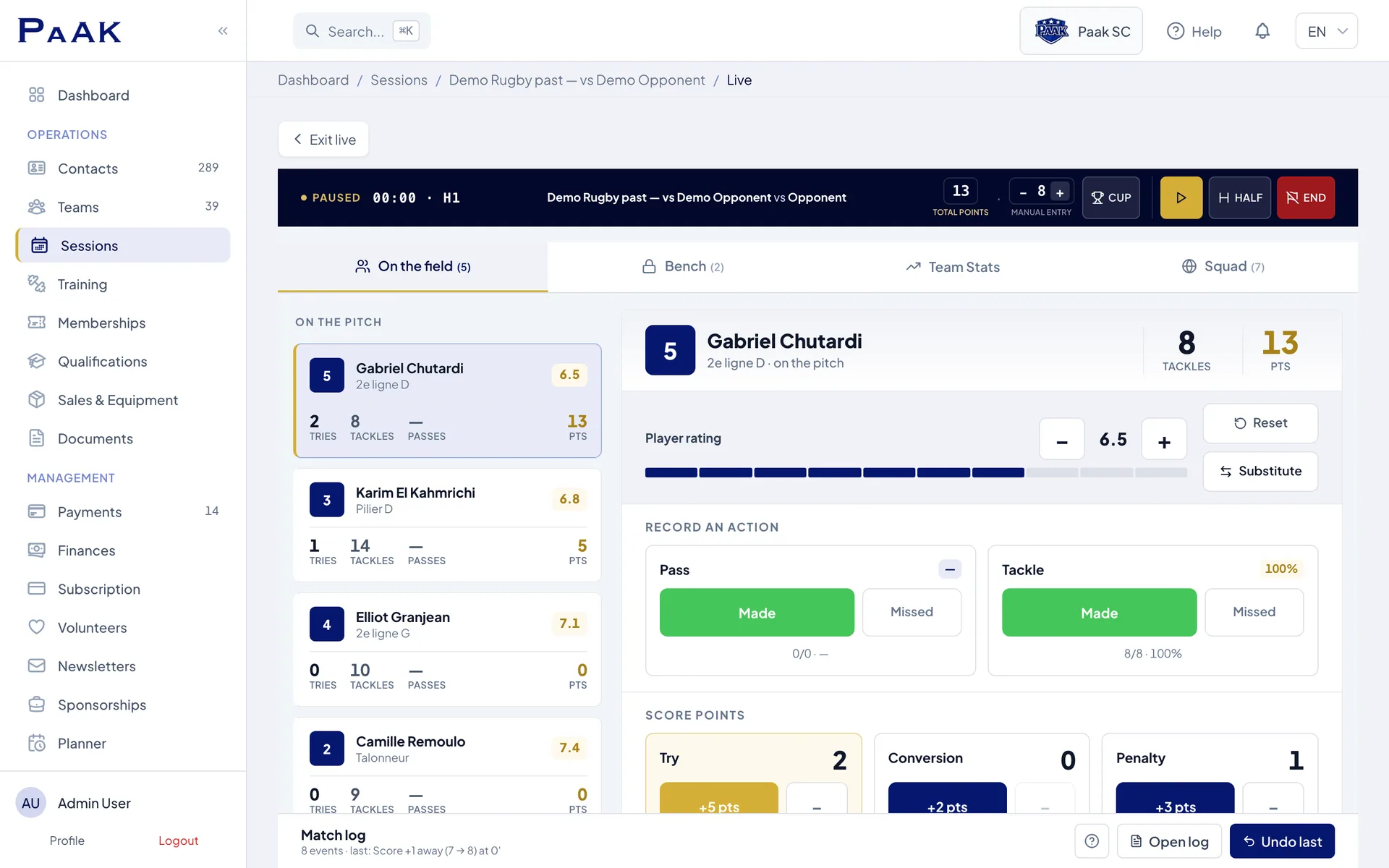
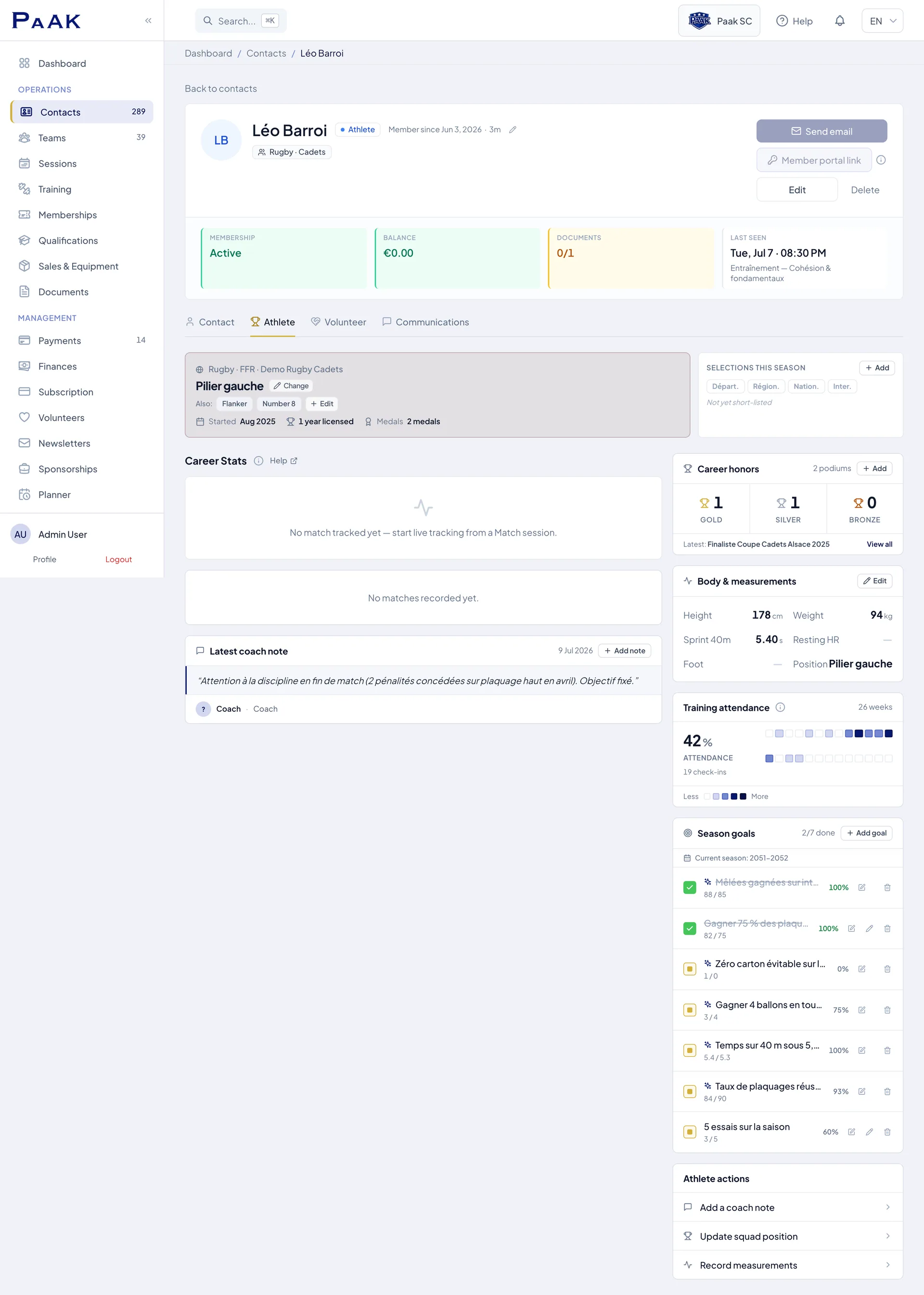
A player profile that adapts to the discipline.
Federation list preconfigured, multiple positions per player (primary + secondary). The stats shown follow the active discipline. Every match action feeds the profile.
- Position, kicking foot, pack side (loosehead / tighthead), jersey number 1 to 23
- Automatic metrics: tries per game, tackles, lineouts won, kicking points
- Turnovers won: particularly tracked for flankers
- XV and Sevens kept separate: each team and match carries its discipline; the profile shows the stats for the discipline you're viewing
The score, in rugby terminology.
No invented stats: exactly the events a rugby coach needs to log. The active discipline determines the stat buttons, the clock and the duration of sanctions.
XVXV mode
- 11 stats: tries, conversions, penalty goals, drop goals, tackles, carries, lineouts won, offloads, mauls driven, breakdown steals, turnovers
- 4 sanctions: yellow card (10 min), red, penalty conceded, free kick
- Numbered positions 1–23 (starters + bench)
7sSevens mode
- 8 stats: tries, conversions, penalty goals, tackles, carries, line breaks, offloads, turnovers
- 3 sanctions: yellow card (2 min), red, penalty conceded
- 7 positions configured
| Action | Points | Tracked per player |
|---|---|---|
| Try | 5 | scorer, discipline, half |
| Conversion | 2 | kicker, kicking points |
| Penalty goal | 3 | kicker, kicking points |
| Drop goal | 3 | kicker, kicking points |
The yellow card triggers the sin-bin: a per-player countdown (10 min XV / 2 min Sevens), stat entry locked while binned, one-click return to pitch when the time is up. The live match tracker is part of Paak Pro.
15 positions, from prop to full-back.
Each position carries its regulatory number and role, pre-configured, with a scrum side for the front row.
1 Loosehead
Prop, front row, scrum.
2 Hooker
Strikes in the scrum, lineout thrower.
3 Tighthead
Prop, front row, scrum.
4-5 Locks
Lineout jumpers, scrum drive.
6 Blindside
Flanker, tackles, support.
7 Openside
Flanker, turnovers, breakdown.
8 Number 8
Back row, carries, scrum base.
9 Scrum-half
Distribution, vision, game control.
10 Fly-half
Kicking, playmaker, goal-kicker.
11/14 Wings
Pace, finishing, counter-attack.
12 Inside centre
Crash ball, distribution, defence.
13 Outside centre
Pace, line breaks, support.
15 Full-back
Kicking, counter, last line.
16-23 Bench
Replacements, finishers, front row.
A full player profile.
Federation list preconfigured, multiple positions per player. Automatic metrics feed the profile match after match.
Position
Federation list preconfigured (15 XV positions / 7 in Sevens).
Kicking foot
Right / left / both.
Jersey number
1 to 23, starters + bench.
Pack side
Loosehead / tighthead.
Federation licence
Licence number, validity dates, medical certificate. Automatic alert before expiry. Adaptable to any national federation.
Discipline
XV and Sevens kept separate: each team and match carries its discipline.
- Tries per game (season average)
- Tackle success rate (tackles made / tackles attempted), in the live match log
- Lineouts won (cumulative count)
- Kicking points (conversions + penalties + drop goals)
- Turnovers won (particularly tracked for flankers)
Federation qualifications, tracked for you.
Refereeing, coaching, youth pathways: each pathway is tracked with its validity and recycling.
Refereeing
Club, district, regional, federal grades. Validity and recycling tracked.
Coaching
Federal coaching pathway adapted to each federation (e.g. France: BE Fed, BPJEPS Rugby, DEJEPS, DESJEPS).
Youth pathways
School rugby coaching certifications (e.g. France: Animateur EDR, Éducateur Fédéral). Ages 6 through 14.
What Paak doesn't do (yet).
Tournaments and competition management
Paak does not yet dedicatedly manage Sevens tournament brackets (pools + knockout phase on a single day) or Union league standings with tie-breakers. Individual matches are tracked, but competition-level aggregation remains manual.
Direct federation licence-portal integration
Most national federation licence portals don't expose public APIs. Licences must therefore be entered in Paak (or imported via CSV from a federation export). Automatic sync doesn't exist, and cannot exist unless the federation opens its API. This is a federation limitation, not a Paak limitation.
Equipment and online sales.
Paak adds an Equipment module that generic club tools don't ship. Two flows in the same table: match kit issued at season start and returned in June (numbered jerseys, shorts, socks, balls), and club catalogue sold online (tracksuits, hoodies, polos, branded bags) with Mollie payment links, VAT split, and automated reminders on unpaid kit.
Distribute
Coach distributes kit from the phone. Price optional.
Mollie link
If priced, Paak sends a Mollie link. Card or SEPA, two clicks.
Paid, accounted
Status flips automatically, VAT split recorded, auto-reminder on delay.
French loi du 8 mars 2024: tracked for you.
The French law of 8 March 2024 makes club presidents personally liable for the honorabilité (background-check status) of every coach, official and adult volunteer in regular contact with minors: in rugby, this covers the head coach, assistants, école de rugby animators, touch judges, assistant referees and any club volunteer present at U6 / U8 / U10 / U12 / U14 / U16 / U19 sessions. Paak makes that tenable for a volunteer-run club.
- Status per coach: valid / expiring soon / expired
- Automatic reminders 30, 14 and 7 days before each attestation expires: email to the coach and notification to the president
- CSV export in the ministry SI Honorabilité / FIJAISV column order, one click
- Federation licence (FFR) and medical certificate on the same coach profile
Honorabilité tracking with the automatic 30/14/7-day reminder cadence is part of Paak One, no per-coach setup.
Rugby, on top of everything Paak already does.
Everything above (XV vs Sevens, 15 positions, per-discipline sanctions, federation licences) is layered on top of the full club management platform. Members, payments, teams, compliance: Paak already handles all of that.
- Member and subscription management (Mollie)
- Match, training, and travel scheduling
- Automated email convocations with RSVP
- Attendance and availability tracking
- Volunteer management (bar, transport, scoretable)
- Medical certificates and federation licences
- Concussion protocol: recovery stand-down (21/23 days) + a "do not play" alert until medical clearance, plus configurable emergency protocols
- Built for GDPR, hosted in France
Three plans, nonprofit rates.
Attendance at training, even offline.
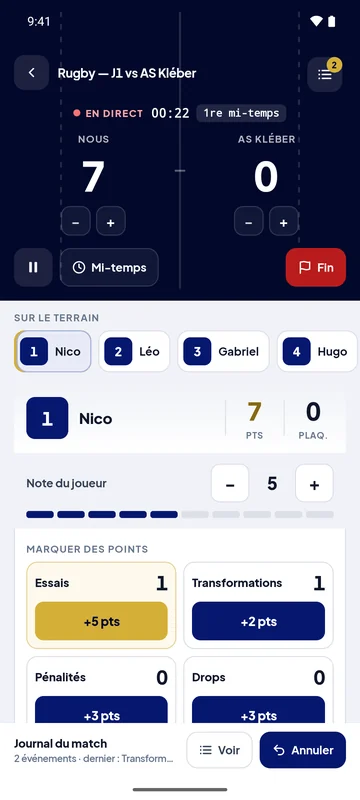
The Paak app for your coaches and club officers: offline attendance, a reminder before each session, the live match with Paak Pro. Included in every plan.

Your members get their own space, no account, no password.
A personal secure link in every club email: schedule and call-ups, dues payable online (“Pay everything” in one payment), medical certificate upload, progression, volunteering.
Simple, transparent pricing
Start free. Upgrade when your club grows. One price, for every club.
- Up to 100 members
- 3 admins, 1 sport, 3 groups
- Member management & CSV import
- Households, emergency contacts & family discounts
- 10 MB of file space
- Sessions & attendance with RSVP
- Collect membership fees online: 1.2% fee (capped at €2.50)
- Session plan on the session: minuted blocks, editable
- Club newsletter + member emails: 50 per month
- Emergency protocols & incidents
- Sponsorship (3 max)
- Staff safeguarding checks (legally required)
- EU-hosted data, built for GDPR
- Member portal for every member: no account, no password
- Public club page: your web presence, in your colors, with registration built in
- Everything in Free, plus:
- 500 members, 5 admins (+€3/seat/mo)
- 3 sports, 10 groups
- Automated payment reminders
- Club-branded emails
- Sponsorship management + sponsor benefits
- Email support
- Sales & equipment (passes, gear)
- Honorability: federation CSV export + auto reminders
- Club newsletter + member emails: 300/mo
- Automated season rollover
- Accounting: income & expense journal + CSV export
- Member documents (medical certificate): encrypted upload + review
- 500 MB of file space
- Printable session sheet + unlimited club-authored drills
- Public page: choose which sections show (fees, teams, venues…)
- 0% Paak fee on online collections
14-day free trial included
- Everything in Paak One, plus:
- Unlimited members
- 10 admin users (+€5/seat/mo)
- Unlimited sports & groups
- Advanced analytics & exports
- Live performance tracking
- Training analytics: planned vs delivered
- Sponsorship ROI & auto-renewal
- Priority support
- Advanced newsletter (rich editor, templates, analytics, 5,000/mo)
- Newsletter merge fields (12 variables)
- AGM financial report · budget · bank reconciliation · XLSX export
- 2 GB of file space
14-day free trial included
Prices shown are net (excl. VAT). VAT not applicable: service exported from Switzerland, reverse charge by the customer (art. 8 para. 1 LTVA).
Accepted payment methods
Frequently asked questions
Does Paak actually distinguish XV from Sevens?
Yes. Two fully separate configurations in code (since April 2026): separate stats, separate sanctions, separate durations, separate formations. A club that plays both activates both disciplines and each match loads the correct configuration.
Are the 15 XV positions tracked separately?
Yes, with their regulatory numbers (1 through 15 for starters, 16-23 for bench) and their role. Each player has a position and, for the front row, a scrum side (loosehead / tighthead).
Is the 10-min / 2-min yellow-card rule handled?
Yes. The yellow card starts a per-player sin-bin countdown: 10 min in XV, 2 min in Sevens (5 min for youth), applied automatically by discipline. The player's stat entry is locked while they're binned, and a « return to pitch » button appears when the time is up. A second yellow (red) removes them for good.
Are set-piece stats (scrums, lineouts, mauls) tracked?
In XV yes: lineouts won, mauls driven, breakdown steals, turnovers won (scrums are a collective pack effort, not an individual stat). In Sevens the set-pieces are fewer, so we track line breaks and offloads instead: the open-play events that decide a 7s match.
Are licences and qualifications tracked?
Yes. Licence number, validity dates, referee grades (club to federal), coaching qualifications (BE Fed, BPJEPS, DEJEPS, DESJEPS in France; adaptable to other federations). Manual entry or CSV import, no automatic sync with federation licence portals, as they don't expose public APIs.
How does Paak distinguish issued kit from sold catalogue?
The Equipment module manages both flows in the same table. Issued: numbered jerseys, shorts, socks, training balls, assigned in September, return tracked in June, payment method 'free'. Sold: tracksuits, hoodies, polos, bags, same distribution, but with a price and a payment method. The module's filter separates the two views when you want to see one or the other.
Can clubs sell tracksuits and club kit online through Paak?
Yes. At every distribution with a price, you pick the payment method: Mollie online link (card or SEPA), cash, check, bank transfer, or free. With Mollie, Paak generates the payment link automatically, the paid status flips on its own, and the VAT split is recorded for the club's accounting. If payment drags on, an automatic reminder goes out on its own.
What does Paak offer for women players' health?
For a team declared women's or mixed, the team page shows a « Breast health » card, on every plan: sports bra and fit, breast knocks to record (58% of 297 Australian women playing Australian football and rugby had had one, Brisbine 2020), signs to have checked, and World Rugby approved chest padding, worn over a sports bra with no underwire. Everything is sourced in the Breast health guide.
Your rugby club, connected in 30 seconds.
If you manage a club that plays XV, Sevens, or both, and your current tool pretends they're the same sport: it's time. Free up to 100 members, no credit card.