Your federation for licences and official competitions
Licences, rankings and official competitions stay with your national federation. Paak does not replace it and is connected to none: it runs what happens at the club.
Paak already manages your members, fees, teams and compliance. For squash it goes further: a player profile with your federation's fields in seven countries, interclub ties in the formats of FFsquash, the Squash-Bundesliga, SWISS SQUASH, the ÖSRV Bundesliga, the Ligue Francophone de Squash and Squash Belgium, or in your own, ready-made training sessions, Squash 11 and Squash 57 on the same profile, and live PAR-11 scoring with Paak Pro.
Free up to 100 members. No credit card.
For a squash club, the federation keeps the licences and the official competitions, Paak runs club life (members, dues, sessions, interclub ties, live match scoring with Paak Pro) and your current files are imported in one go. The two complement each other: Paak does not replace the federation.
Licences, rankings and official competitions stay with your national federation. Paak does not replace it and is connected to none: it runs what happens at the club.
Members, dues, sessions and attendance, interclub ties, live match scoring with Paak Pro; for clubs in France, honorabilité tracking for coaches. On a computer and on your coaches' phones. Free up to 100 members.
Create my club for free →Imported in one go: Paak recognises the columns and you check the rows before the import. If you prefer, send us your list and we import it for you, free.
On 16 October 2023, the 141st IOC Session, in Mumbai, added squash to the programme of the Los Angeles 2028 Games, after two unsuccessful votes, in 2009 (golf and rugby sevens chosen) and in 2013 (wrestling kept). It will be squash's first appearance at the Olympic Games: two events, men's singles and women's singles, 16 players each, from 15 to 24 July 2028 at the Comcast Squash Center, at Universal Studios. The decision is for that edition.
What a club can prepare with Paak before then: online registration, the public club page with its groups and their weekly slots, the Les Balles levels on young players' profiles, and ready-made training sessions.
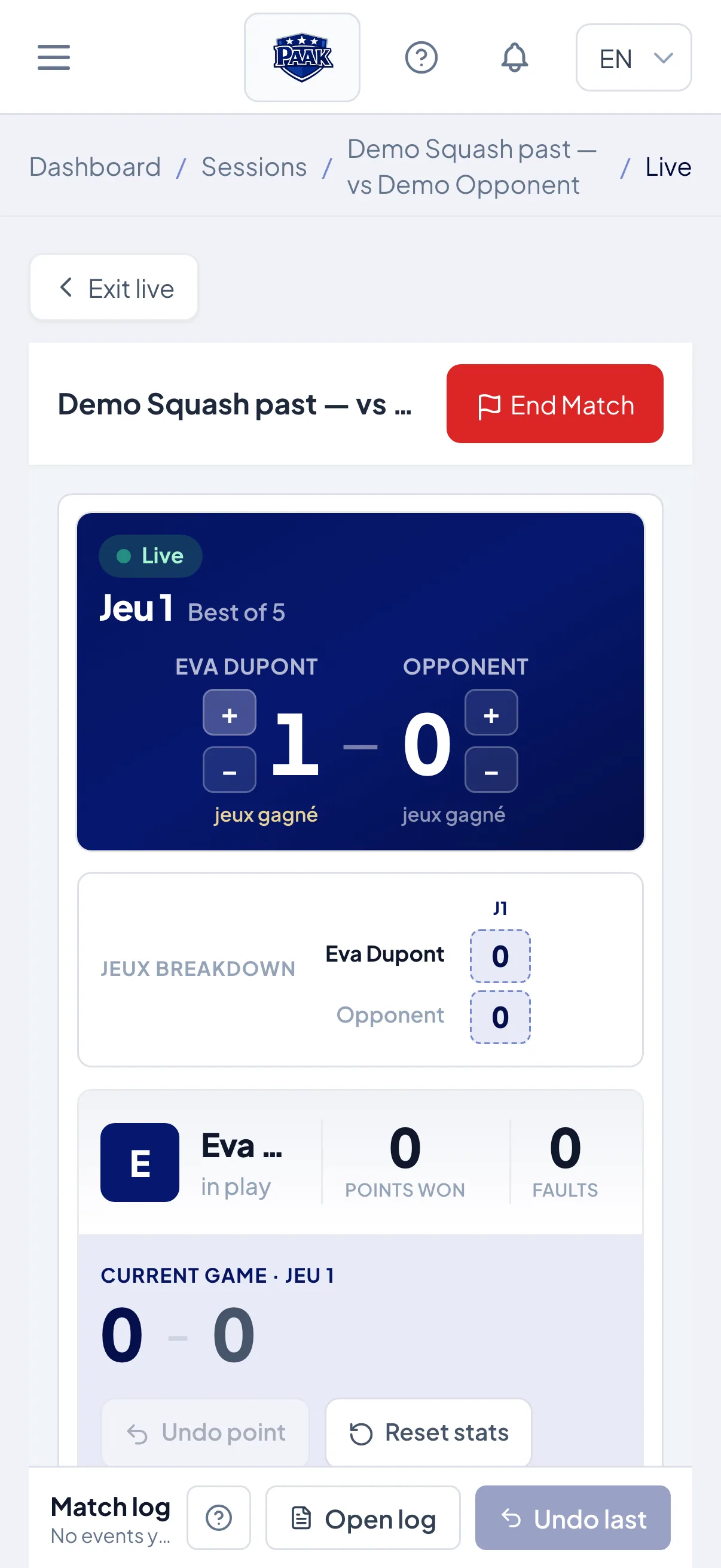
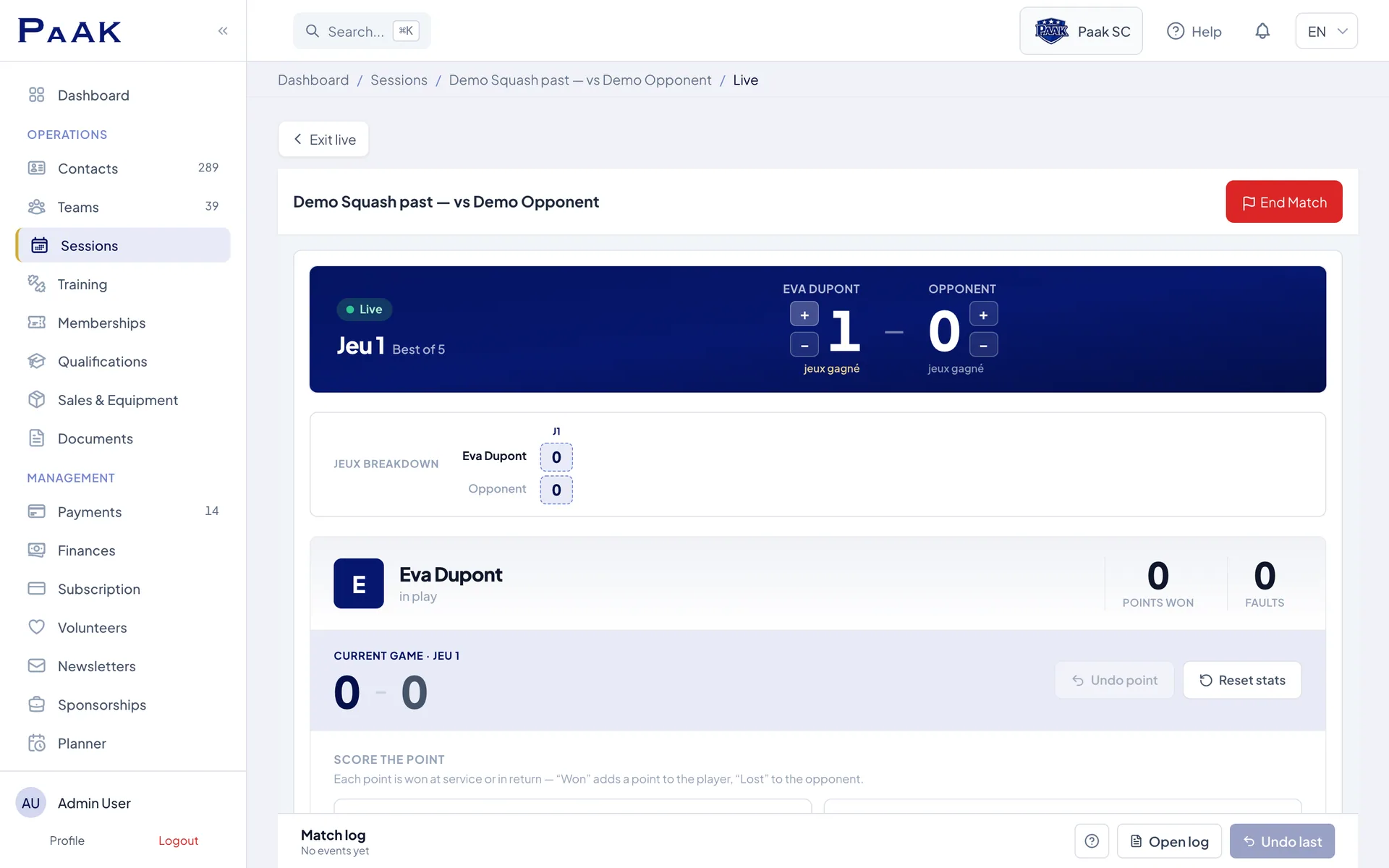
During the match, you tap the player who wins the rally. Paak asks once who serves first, then counts games to 11 with a 2-point margin, shows the 10-all call when the score gets there (a player must win by 2 points), flags game point and match point, and knows at every rally who serves and from which box. Live scoring is part of Paak Pro.

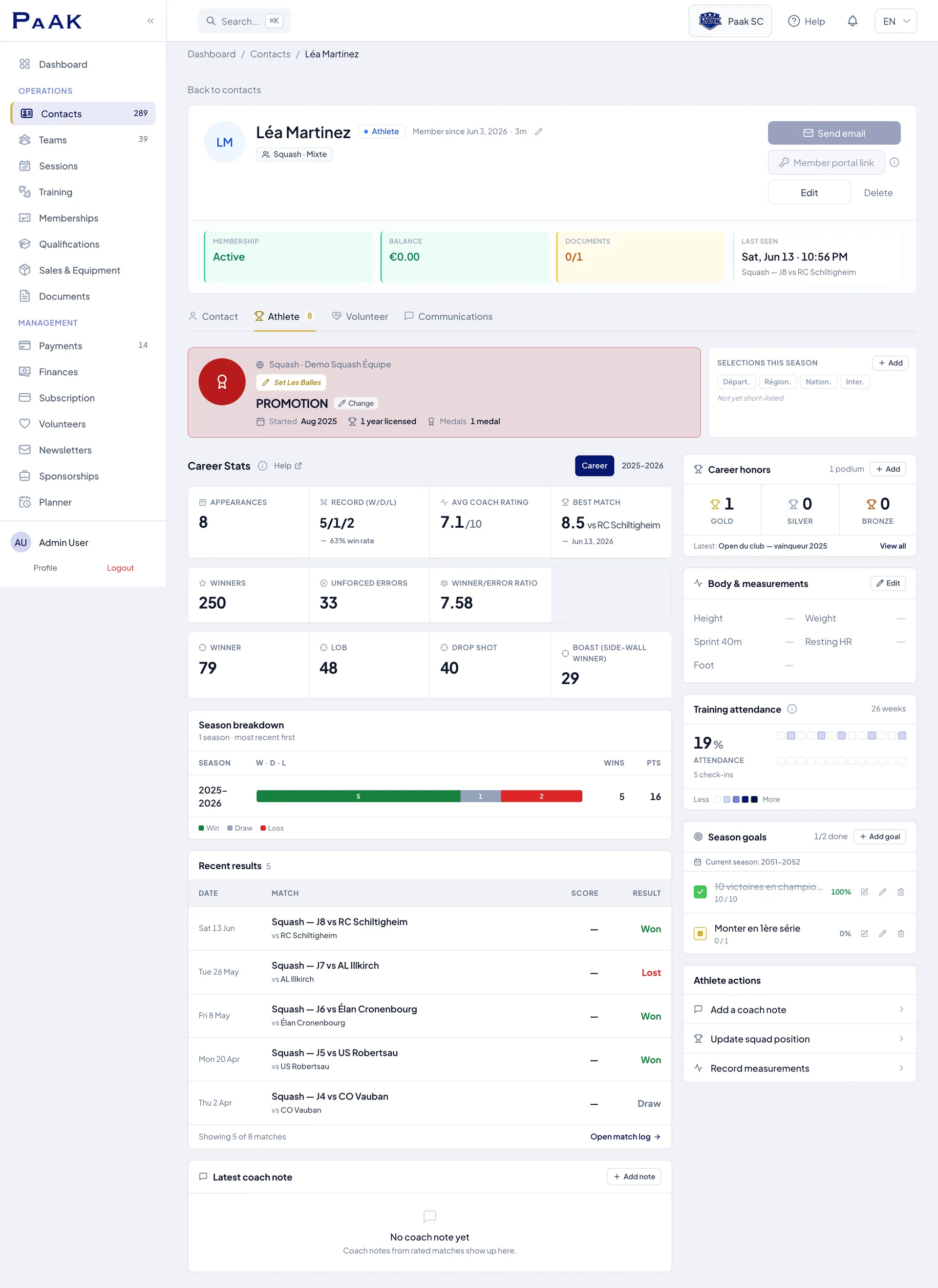
Every action in a match feeds the profile. The nick share of winners says something specific: millimetric precision on attacking shots. The FFsquash player profile keeps the preferred variant, playing style, playing hand and ranking.
While you are on court, the club keeps running: members register online from your club’s public page, pay their fees and sign their waivers, and everything lands in your dashboard, with nothing to re-type.
Included from the free plan: public page and member portal on every tier.
FFsquash governs two formats. Paak handles both within the same player profile, with a preferred-variant field that helps the coach place each member into the right training slot.
Competition squash. Every rally scores a point, a game is won at 11 with a 2-point margin from 10-10, and the match is best of 5 games: that is PAR-11.
A discipline of its own, which FFsquash governs too: a bigger and slower ball, on the same court.
Both variants live on the same profile. The preferred-variant field says who plays Squash 11, Squash 57 or both, and helps the coach build training slots. Live scoring counts in PAR-11: Paak has no scoreboard of its own for Squash 57.
The nine levels of Les Balles, the FFsquash junior school, are picked from a list on the young player's profile, from Pastille bleue to Balle blanche. The club educator assesses each child continuously, with no one-off test, and updates the level on the profile.
The level is awarded by the club educator, and Paak shows it as a badge on the young player's profile. The official diploma is downloaded from the FFsquash website.
During the match a tap adds each shot to the player's profile, from your phone, courtside: four winning shots (winner, nick, drop shot, boast), the defensive lob and two errors (tin, unforced error). The scoreboard looks after the rest: it works out who serves and from which box, counts the points won on serve and on return, and keeps the count of the lets, strokes and no lets you decide. The Impact column says what each statistic weighs in the player's match rating. Live scoring is part of Paak Pro. Paak does not rate children: it is not offered to teams aged 12 and under.
| Statistic | Impact | Use |
|---|---|---|
| Winner | +2 | Clear winner (drive, kill, unreturnable finish) |
| Nick | +2 | Ball dies on the floor-side-wall join: squash signature, unreturnable |
| Drop shot | +1.5 | Soft shot dying near the front wall before the back-court bounce |
| Boast | +1.5 | Side-wall winner: geometric attacking trick shot |
| Defensive lob | +0.5 | High recovery shot to neutralise an attack |
| Stroke (interference point) | +1 | Point awarded on opponent's interference: signals strong T-position |
| Tin (bottom-strip error) | −1.5 | Strike on the front-wall bottom strip: automatic loss of rally |
| Unforced error | −1.5 | Out of court, second bounce, not-up |
| Stroke conceded | −1 | Point given to the opponent on their request for a let |
| Let (rally replayed) | 0 | The rally is replayed on the player's request, the score does not move |
In a generic tool, a nick is counted as an ordinary winner. Yet the nick (the ball that strikes precisely the corner where floor meets side wall and rolls flat) is squash's signature shot. Its frequency in a player's profile says something very specific: millimetric precision on attacking shots. Paak surfaces it as its own stat for this reason: the nick share of winners is one of the calculated profile metrics.
The World Squash (WSF) rules set four conduct penalties, from the Conduct Warning to the Conduct Match. Paak offers them on the scoreboard: it applies each one's effect to the score, and each one weighs on the player's match rating.
| Level | Effect |
|---|---|
| Conduct Warning | Nothing changes on the score. −0.5 on the match rating |
| Conduct Stroke | One point to the opponent. −1.5 on the match rating |
| Conduct Game | The game to the opponent; the player keeps the points already scored. −3 on the match rating |
| Conduct Match | The match to the opponent. −5 on the match rating |
Free entry: Paak accepts the number exactly as it appears on the licence, so no valid licence is ever rejected.
Numeric field. Enter the value communicated by your regional league. More precise than a truncated category name, and forward-compatible with future nomenclature changes.
Free entry: type the exact label given by your league, and it stays visible on the player's profile.
The FFsquash categories, picked from a list: Mini-Squash (3-6 years), École de Jeunes (7-10), U11, U13, U15, U17, U19, Espoirs (under 23), Senior, Vétérans (35 and over).
Squash 11 (PAR standard), Squash 57 (ex-Racketball, slower ball), or both. Helps allocate members to the right training sessions.
Attacking, defensive, all-round, touch. Tactical input for match coaching and interclub team composition.
Right, left, ambidextrous. PSA world ranking is optional, reserved for tour-level professional players.
Weight in grams (110-200; ultra-light 110-145 typical). Fastest shot speed in km/h captured by radar, useful for season-long physical assessments.
Create the tie in the format of your league: FFsquash interclubs, the Squash-Bundesliga, the SWISS SQUASH Interclub, the ÖSRV Bundesliga Austria, the Ligue Francophone de Squash interclubs or the Squash Belgium Nationale ERE; or set your own format for any other league. You call up your players with attendance confirmation, and Paak works out the tie score from the matches.
In Paak: each match counts in its players' records, the tie once in the team's. The official ranking and results stay with your federation.
The player profile and the interclub sheet follow the club's country. Here is what Paak carries today, country by country, and where you set things yourself.
Profile: SWISS SQUASH strength class (C4 up to A1), ranking points, age class.
League: SWISS SQUASH Interclub, men 4 players (NLA to 3rd league), women 3 players (NLA to 1st league). On a 2:2 in the men's format, Paak says which team has the better draw: games, then points, then the number ones.
Profile: DSQV licence number, position in the German ranking, age class.
League: Squash-Bundesliga, men 4 players, women 3 players.
Profile: ÖSRV ranking points, age class.
League: ÖSRV Bundesliga Austria, men 4 players, women 3 players.
Profile: Squash Vlaanderen member number and classification, ranking points (Squash Vlaanderen or Ligue Francophone de Squash), age category.
League: Ligue Francophone de Squash interclubs (3 players) and Squash Belgium Nationale ERE (4 players). The Squash Vlaanderen interclub counts a tie in games won, which the sheet does not do: a Flemish club uses the custom format.
Profile: US Squash rating (USR), age division.
League: no US Squash league format is built in: use the custom format.
Profile: SqA ID number, SquashLevels level, AJST ranking for juniors, age group.
League: no state pennant format is built in: use the custom format.
Profile: the fields common to every country; no England Squash fields today.
League: no county league format is built in: use the custom format.
Profile: PSA world ranking, playing hand, playing style, preferred variant (Squash 11 or Squash 57).
League: the custom format, where the club sets the number of singles.
The same everywhere: the live board follows the World Squash singles rules, and every league format is singles, best of 5 games to 11. No federation is connected to Paak: members come in by CSV import and the federation values are typed on each profile.
FFsquash runs the federal channel: licences, national rankings, tournament sanctioning, national championships. Paak does not replace this channel. It handles everything else: the day-to-day life of the club.
FFsquash licence, official ranking points, tournament sanctioning, interclub championship registration, federal declarations.
Members, fees, Mollie payments, honorabilité tracking for coaches (French law of 8 March 2024), live performance, communications, volunteers, sponsors, multi-sport.
No public FFsquash API as of today. Your licensed players come in by CSV import of an export from the federal portal; the licence number and ranking are then entered on each profile. Nothing goes back from Paak to FFsquash: the official licence and ranking are still handled on the federal portal.
This section applies to clubs in France. The French law of 8 March 2024 makes club presidents personally liable for the honorabilité (background-check status) of every coach, official and adult volunteer in regular contact with minors. In squash, this covers the head coach, assistants, mini-squash and Les Balles session leaders, club markers and any volunteer present at youth sessions or youth interclub matches.
Everything above (squash scoring, conduct penalties, the player profile, calculated metrics, interclub ties) sits on top of the full club-management platform. Members, fees, scheduling, board governance: Paak already runs all of it.
The Paak app for your coaches and club officers: offline attendance, a reminder before each session, the live match with Paak Pro. Included in every plan.

A personal secure link in every club email: schedule and call-ups, dues payable online (“Pay everything” in one payment), medical certificate upload, progression, volunteering.
Start free. Upgrade when your club grows.
See the prices for your country
14-day free trial included
Prices shown are net (excl. VAT). VAT not applicable: service exported from Switzerland, reverse charge by the customer (art. 8 para. 1 LTVA).
Is your club in one of these countries? It has its own prices: Switzerland · United Kingdom · United States · Canada · Australia · Morocco · Tunisia · Algeria · Egypt · South Africa · Türkiye · Senegal · Côte d’Ivoire
Accepted payment methods
Yes. On your group's session, pick an age group, a length (45, 60, 75 or 90 minutes) and one of five themes: movement and ghosting; length and solo practice; serve, return and length; short game and boast; volley and interception. Paak builds a timed session (warm-up, two main blocks, a conditioned game, cool-down) from 32 drills based on squash's published references: the WSF rules, FFsquash documents, and the England Squash and Squash Canada programmes, cited as such. They are exactly the drills of the Côté Coach squash guide, free to read. Every drill carries the reminder that juniors wear certified protective eyewear, and several say which ball to pick for the group's level. Planning, editing and saving the session is free; printing the session sheet and club-made drills beyond 5 are in Paak One.
Yes, with Paak Pro. You tap the player who wins the rally: Paak counts games to 11 with a 2-point margin, works out who serves and from which box, and counts the points won on serve and on return. A request for a let is answered in one tap: let, stroke or no let, and the match keeps the count of all three for each player. Shots are logged next to the score: winner, nick, drop shot, boast, lob, tin and unforced error. The match is best of 5 games, or best of 3 if you choose it before the first point. No substitutions: it is one against one. Paak does not rate children: live scoring is not offered to teams aged 12 and under, and for ages 13 to 18 the coach first confirms a short reminder.
Yes, on the profile. Each player has a preferred variant: Squash 11, Squash 57 (formerly Racketball, a bigger and slower ball) or both, which helps the coach build training slots. Live scoring counts in PAR-11: Paak has no scoreboard of its own for Squash 57.
On 16 October 2023, the 141st IOC Session, in Mumbai, added squash to the programme of the Los Angeles 2028 Games: it will be squash's first appearance at the Olympic Games. Two events, men's singles and women's singles, 16 players each, from 15 to 24 July 2028. The decision is for that edition; nothing is decided beyond it. What a club can prepare with Paak: online registration, a public club page with its groups and their weekly slots, the Les Balles levels on young players' profiles, ready-made training sessions, and a newsletter sent to all members or to one team.
Yes, on each player's profile: the FFsquash licence number, the ranking points (a number), the ranking category (free text: type the exact label your league gives you, it is saved as typed) and the FFsquash age category, picked from a list (Mini-Squash 3-6, École de Jeunes 7-10, U11, U13, U15, U17, U19, Espoirs under 23, Senior, Vétérans 35 and over). Paak keeps what you enter: the official licence and ranking stay with FFsquash.
Yes. Create the tie in a league format Paak carries: FFsquash interclubs, the German Squash-Bundesliga, the SWISS SQUASH Interclub, the Austrian ÖSRV Bundesliga, the interclubs of the Ligue Francophone de Squash or the Squash Belgium Nationale ERE; for any other league, set your own format (the number of singles). Every format is singles, best of 5 games to 11. Each match score is entered game by game, on every plan, and checked against the format; a match can also be scored live with Paak Pro. Paak works out the tie score and, where the league's rules name a better draw at 2-2 (FFsquash, SWISS SQUASH men, Squash-Bundesliga men), says which team takes it. In the FFsquash play-offs you can stop the tie at the decided score when both captains agree.
Yes. The live board follows the World Squash singles rules, the same in every country. The player profile carries the fields of the club's country: in Switzerland the SWISS SQUASH strength class (C4 up to A1), ranking points and age class; in Germany the DSQV licence number, the position in the German ranking and the age class; in Austria the ÖSRV ranking points and age class; in Belgium the Squash Vlaanderen member number and classification, the ranking points and the age category; in the United States the US Squash rating and age division; in Australia the SqA ID number, the SquashLevels level, the AJST ranking for juniors and the age group. In every country: PSA world ranking, playing hand, playing style and preferred variant. The interclub sheet carries the SWISS SQUASH Interclub, the Squash-Bundesliga, the ÖSRV Bundesliga, the Ligue Francophone de Squash interclubs and the Squash Belgium Nationale ERE; for any other league you set a custom format. A club in the United Kingdom gets the fields common to every country, with no England Squash fields today, and uses the custom format for its county league. No federation is connected to Paak: members come in by CSV import and the federation values are typed on each profile.
Yes. Paak keeps the FFsquash licence number and ranking points on each profile, tracks honorabilité for coaches (French law of 8 March 2024), handles membership fees and their online payment, runs the ties of the Championnats de France Interclubs, training, tournament and camp scheduling, and the coaching and refereeing diplomas you record. No public FFsquash API as of today: your licensed players come in by CSV import of an export from the federal portal, and licence numbers and ranking points are entered on each profile.
Yes, as a named level on the young player's profile, picked from the list of the nine FFsquash levels, from Pastille bleue to Balle blanche. The club educator assesses each child continuously, with no one-off test, and updates the level; the official diploma is downloaded from the FFsquash website. And in matches, Paak does not rate children: live scoring is not offered to teams aged 12 and under.
Yes. Each group (say the junior school on Wednesday, adult leisure on Thursday evening) shows its weekly slots on the club's public page and in the online registration form. Parents pick the group, the coach or a club officer accepts the request, and you can set a number of places and open a waiting list. It is included in every plan.
Members and fees, player profiles, interclub ties, ready-made sessions: it's all ready. Free up to 100 members, no credit card; live scoring is part of Paak Pro.