The software that speaks fencing — three weapons, one tool.
Paak already runs your members, dues, teams and compliance. For fencing it goes further: foil, epee and sabre in distinct configurations, a live Red/Green scoreboard with a live trend (momentum), touch economy per bout, FFE licence, ranking from NC to International.
- Three weapons, three logics — right-of-way for foil/sabre, double touch for epee: the buttons change with the weapon
- Red/Green scoreboard + live trend — statistics for the maître d'armes, not refereeing
- Child-safeguarding compliance — maîtres d'armes and staff tracked, reminders before expiry
Free up to 100 members. No credit card. 30-second setup.
Everything a salle d'armes runs, in one tool.
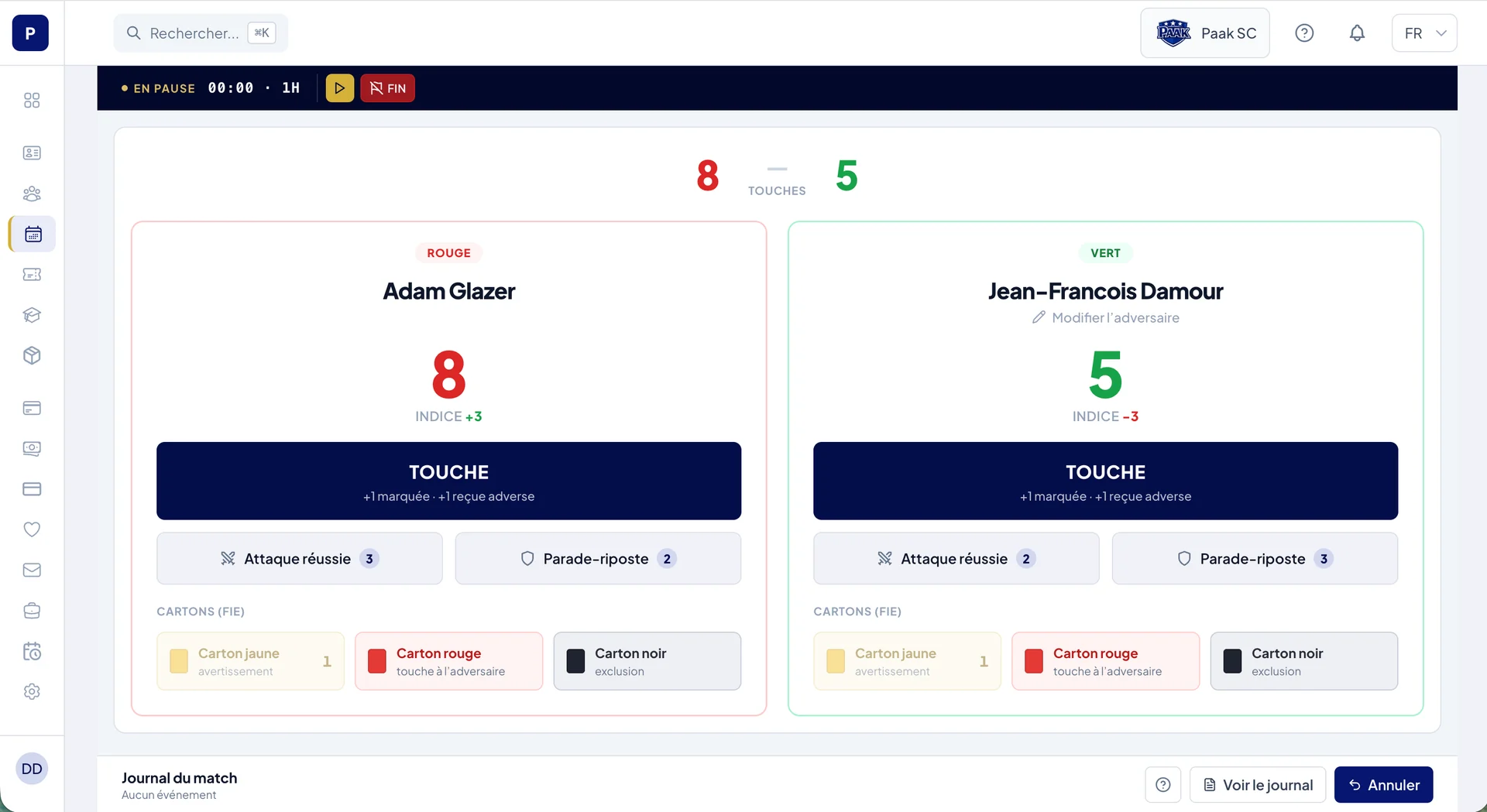
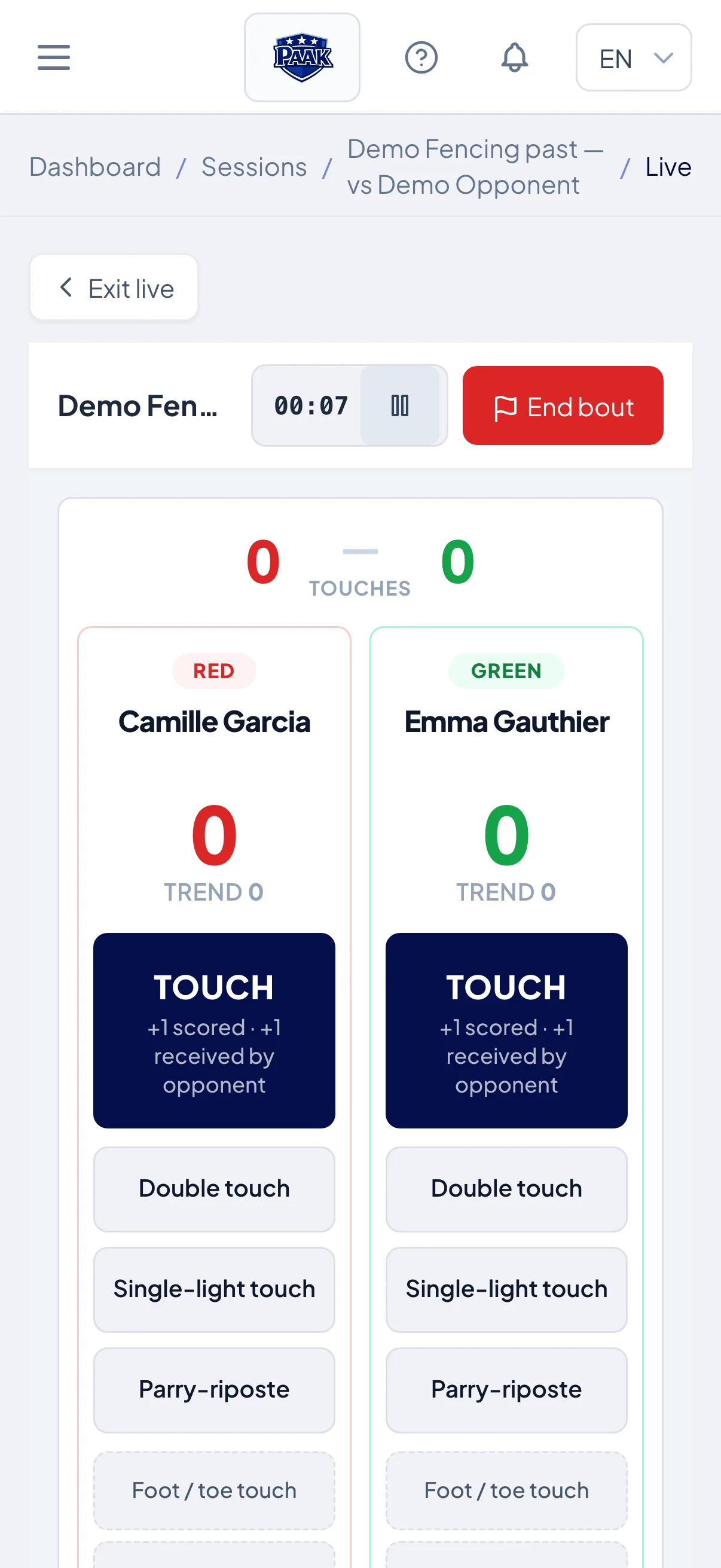
Red / Green scoreboard, live trend.
The tracker shows two columns — Red and Green — with a real-time aggregate score. Each touch scored increments the fencer's column; each touch received counts for the opponent. A trend (the touch differential) shows the bout's momentum. Weapon-specific buttons layer onto the tally without visual noise. The live tracker is part of Paak Pro.
- Live trend — the touch differential in real time, a momentum cue during the bout
- FIE cards — yellow / red / black, native buttons, timestamped during the bout
- Statistics, not refereeing — the jury and signal apparatus remain the sole judges
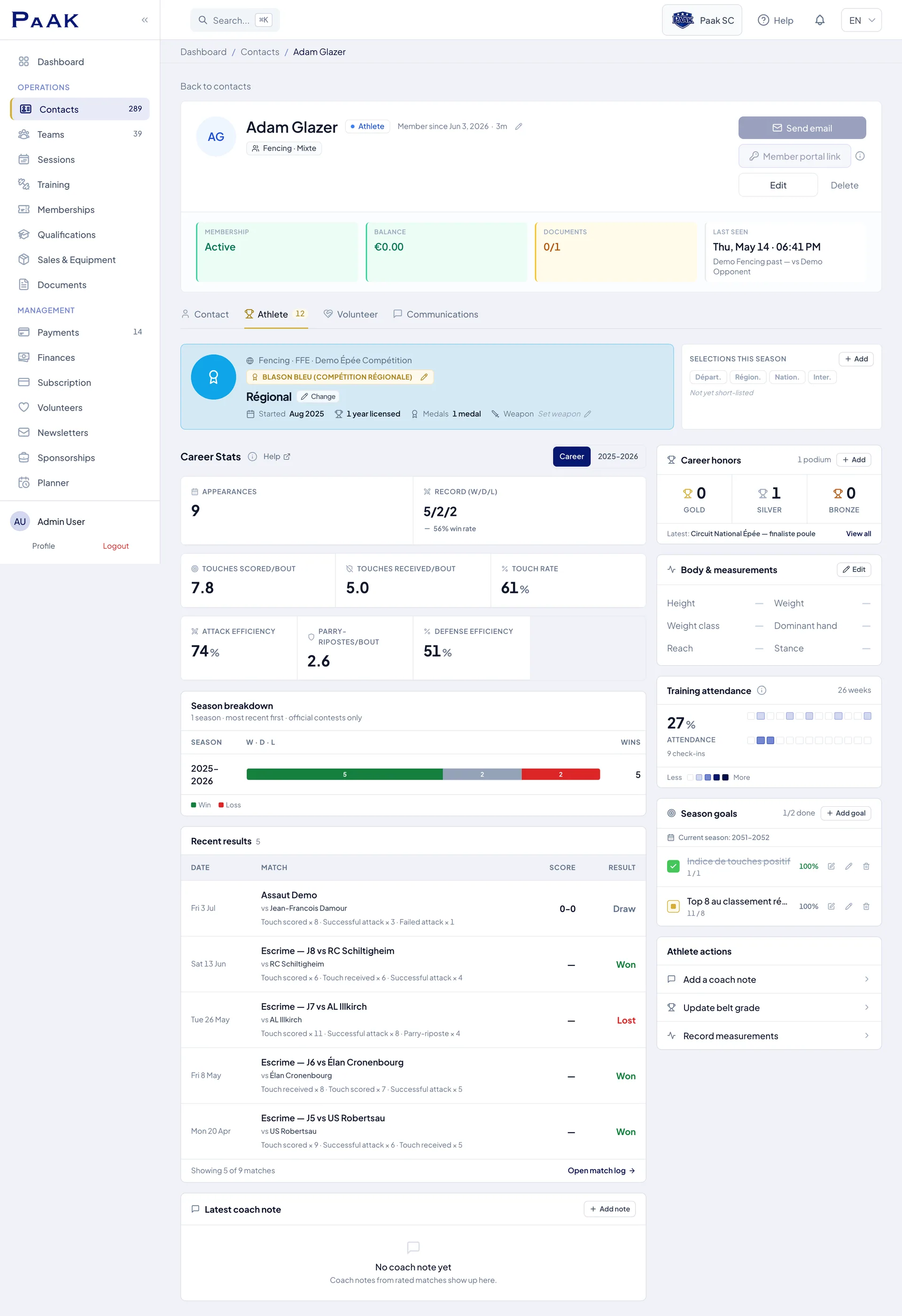
A profile that speaks fencing — weapon, ranking, efficiencies.
Every bout feeds the fencer's profile: preferred weapon, weapon hand, grip, age category, FFE ranking, and four metrics computed automatically that every maître d'armes reviews at season's end.
- Touches scored / received per bout, hit rate, offensive and defensive efficiency — every bout
- Weapon hand & grip — right/left, French/Italian/pistol: tactical data
- FFE ranking — hierarchical level + numeric position, on the same profile
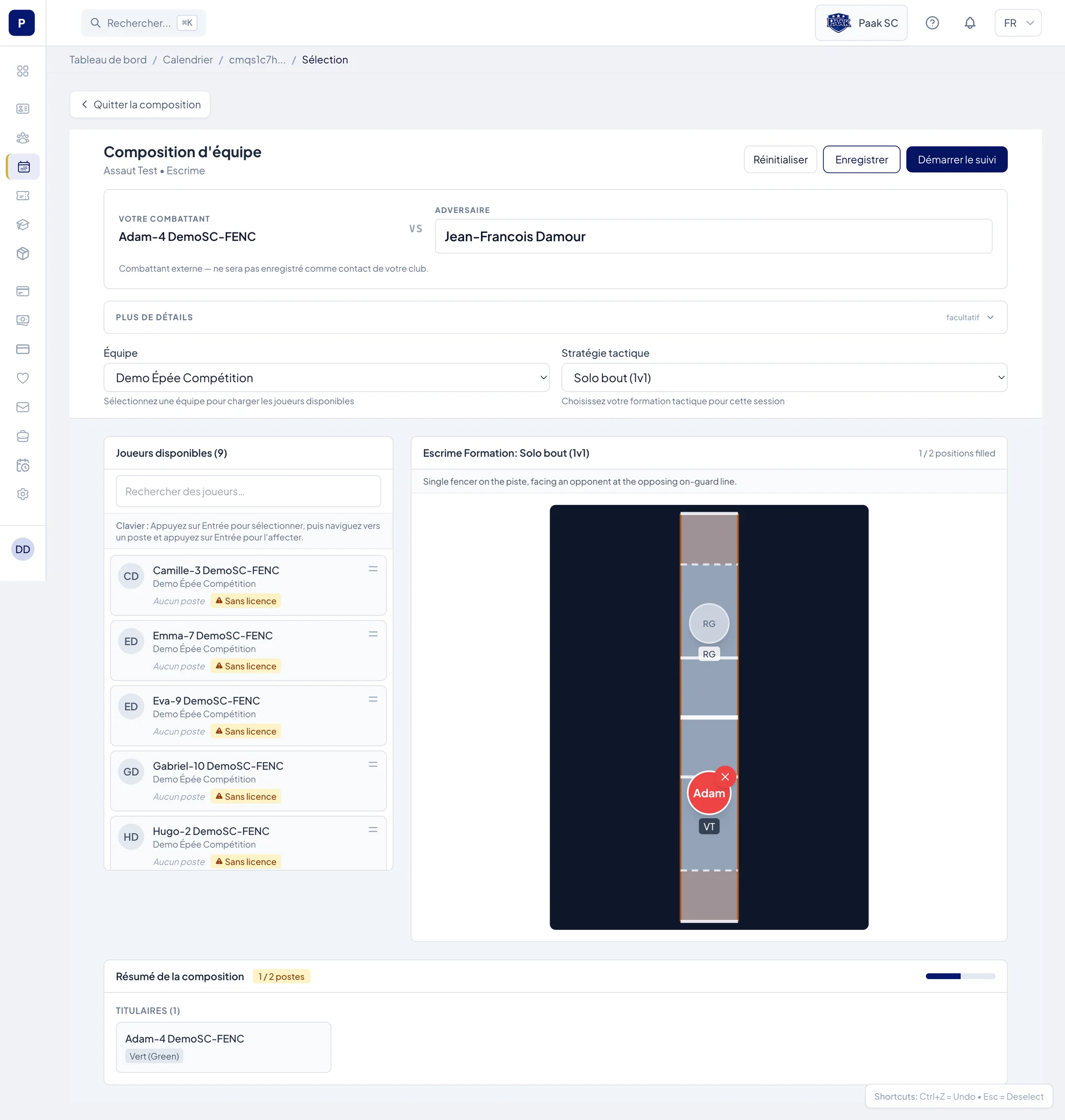
Build the bout line-up — fencers, formation, piste.
Before the match, Paak sets the line-up: who fences, in which formation, on which piste. Drag available fencers into the composition, pick the bout format, then start tracking in one tap.
- Available fencers — the whole squad, licence and status at a glance, keyboard selection
- Formation on the piste — the bout format (solo 1-on-1…) shown on the FIE piste before the en-garde
- Line-up saved — starters and reserves carried from one match to the next, ready to track
Less admin, more fencing.
While you are on the piste, the club keeps running: members register online from your club’s public page, pay their fees and sign their waivers — and everything lands in your dashboard, with nothing to re-type.
Included from the free plan — public page and member portal on every tier.
- Online registration from your club’s public page — no more paper forms
- Fees by card or SEPA direct debit, in one or several instalments per your plans
- Waivers and image-rights consent signed online, timestamped
- A member portal with no account, no password: schedule, payments, documents
- Automatic reminders and follow-ups — fees, licences, certificates
- One-tap roll call, attendance tracked session after session
Foil, epee, sabre — structurally different rules.
A generalist tool treats the three weapons as a single discipline. In reality, target, right-of-way and the way you touch all change. Paak encodes each weapon in its own configuration — the statistic buttons and the tracker change with the weapon.
Foil
Attack with priority, riposte, counter-attack, remise. Off-target (non-valid) touch tracked separately: it stops the action without scoring.
Epee
Double touch (both lights) as a primary statistic. Single, foot, hand touch — breakdown by body part for tactical reading.
Sabre
Flunge / flying lunge (the flèche has been illegal in sabre since 1992), beat-attack, riposte. Cut and thrust distinguished — sabre is the only weapon accepting both modes.
Five base statistics, one button per touch.
The maître d'armes picks the most descriptive statistic (parry-riposte, attack with priority, fleche…) rather than the generic button. The scoreboard and the trend stay accurate because each button carries its own +1 or −1.
Touches per bout
scored / bouts · received / boutsHit rate
scored / (scored + received)Offensive efficiency
successful attacks / totalDefensive efficiency
parry-ripostes / touches receivedThe FFE ranking is not a letter — it's a position within a level.
Computed by a federal logarithmic formula, the ranking is a numeric position per weapon and per age category. Paak exposes it in two fields: a hierarchical level (drop-down list) and a free-text position, copyable from the FFE extranet.
Yellow Blason
1st levelRed Blason
2nd levelBlue Blason
regional competitionGreen Blason
young refereeThe Blue Blason is required to enter a fencer in regional competition; the Green Blason certifies the fencer as a young referee. Paak keeps the history: maître d'armes, date, technical test validated.
Good to know: automated ranking import from the FFE extranet would require a public FFE API — none exists today (verified April 2026). Import is by CSV and the FFE licence number is a text field on the profile.
Blades, masks, lames — inventory tracked, and sold.
A 50-fencer club means 80 blades, 60 body cords, 40 lames, 30 certified masks. Paak manages this inventory as the natural extension of your member file — each item has a record, an assignment, a status and a next-check date.
- Blades & weapons by serial number, FIE-certified masks (350N, 1000N) with check dates
- Distribution from the coach's phone at training, returns tracked at season's end
- Online sale — a tracksuit or mask distributed with a price → Mollie link (card/SEPA), VAT split, auto reminder
Paak, Belle Poule and the FFE extranet — complementary.
The French fencing ecosystem rests on tools Paak doesn't try to replace. Paak isn't on the FIE list of software certified to run a competition: that's not the goal. Paak runs the club, between competitions.
Stay your official reference
- FFE extranet: affiliation, licences, official calendar, rankings
- Belle Poule: pools, direct-elimination tableaux, result transmission to the FFE
- Open-source, federation-recognised file format
What you gain on top
- Memberships and dues online (Mollie card + SEPA), automatic reminders
- The bout, live: 3 weapons, Red/Green scoreboard, trend, cards
- Email convocations with RSVP and D-1 reminders
- Child-safeguarding (loi 8 mars 2024) — maîtres d'armes tracked
- Equipment inventory, Mollie sales, multi-sport, hosting in Europe
Instructor checks, tracked for you.
In fencing this covers the maître d'armes, prévôts and preparers, fencing-school coaches, referees and any volunteer at youth sessions. Paak tracks each person's clearance date and alerts before it expires.
- Status per maître d'armes — valid / expiring soon / expired
- Automatic reminders at 30, 14 and 7 days before expiry
- One-click CSV export in the format your authority expects
- FFE licence, diploma and medical certificate on the same profile
Your members get their own space — no account, no password.
A personal secure link in every club email: schedule and call-ups, dues payable online (“Pay everything” in one payment), medical certificate upload, progression, volunteering.
Simple, transparent pricing
Start free. Upgrade when your club grows. One price, for every club.
- Up to 100 members
- 3 admins, 1 sport, 3 groups
- Member management & CSV import
- Households, emergency contacts & family discounts
- Sessions & attendance with RSVP
- Collect membership fees online — 1.2% fee (capped at €2.50)
- Session plan on the session — minuted blocks, editable
- Emails to members — 50 per month
- Emergency protocols & incidents
- Sponsorship (3 max)
- Staff safeguarding checks (legally required)
- EU-hosted data, GDPR compliant
- Member portal for every member — no account, no password
- Public club page — your web presence, in your colors, with registration built in
- Everything in Free, plus:
- 500 members, 5 admins (+€3/seat/mo)
- 3 sports, 10 groups
- Automated payment reminders
- Club-branded emails
- Sponsorship management + sponsor benefits
- Email support
- Sales & equipment (passes, gear)
- Honorability: federation CSV export + auto reminders
- Club newsletter + member emails — 300/mo
- Automated season rollover
- Accounting: income & expense journal + CSV export
- Member documents (medical certificate) — encrypted upload + review
- Printable session sheet + unlimited club-authored drills
- Public page: choose which sections show (fees, teams, venues…)
- 0% Paak fee on online collections
14-day free trial included
- Everything in Paak One, plus:
- Unlimited members
- 10 admin users (+€5/seat/mo)
- Unlimited sports & groups
- Advanced analytics & exports
- Live performance tracking
- Training analytics: planned vs delivered
- Sponsorship ROI & auto-renewal
- Priority support
- Advanced newsletter (rich editor, templates, analytics, 5,000/mo)
- Newsletter merge fields (12 variables)
- AGM financial report · budget · bank reconciliation · XLSX export
14-day free trial included
Prices shown are net (excl. VAT). VAT not applicable — service exported from Switzerland, reverse charge by the customer (art. 8 para. 1 LTVA).
Accepted payment methods
Frequently asked
Does Paak handle the three weapons separately?
Yes. Foil, epee and sabre have distinct configurations because their rules are. Each weapon has its own statistics (attack with priority for foil/sabre, double touch for epee, flunge for sabre, off-target for foil).
Does the live scoreboard do the referee's job?
No — it's a statistics tool for the maître d'armes, not refereeing. The signal apparatus and the jury remain the sole judges of the official verdict. The Red/Green scoreboard captures what the maître d'armes reviews after the bout.
Does Paak replace the FFE extranet or Belle Poule?
No. The FFE extranet stays the reference for licences, affiliation and the calendar; Belle Poule stays the tool to run a competition. Paak runs the club's daily life between competitions. Federation data flows in by CSV until a public FFE API exists.
How does Paak integrate the FFE ranking?
Not by letters — the FFE ranking is a numeric position within a level (NC to International), computed by a federal logarithmic formula. Paak exposes two fields: a level (drop-down list) and a free-text position, copyable from the extranet.
Does Paak track fencing equipment inventory?
Yes. Blades by serial number, FIE-certified masks (350N, 1000N), body cords, lames, plastrons and embroidered apparel. Status (available / distributed / broken / under repair), assignment, next-check date. Sale possible with a Mollie payment link.
Do you offer training resources for maîtres d'armes?
Two things, and they are distinct. The Fencing training knowledge base is freely accessible: foil, épée and sabre treated separately, age-band priorities, a session builder, drills with progressions, the individual lesson and sourced guides (FIE/FFE, federation manuals, peer-reviewed research). And inside the app, the session generator builds a minuted outline — warm-up, two main blocks, a game, cool-down — from the age band, duration and theme you pick, right on your club's session. Planning, editing and saving the session is free; printing the session sheet and club-authored drills beyond 5 are available in Paak One.
Your salle d'armes, connected in 30 seconds.
3 weapons, Red/Green scoreboard + trend, touch economy per bout, FFE ranking, Blasons, safeguarding — it's all ready. Free up to 100 members, no credit card.