From the Excel spreadsheet to live 6v6 scoring. Amateur volleyball, connected.
Paak already handles your members, payments, teams and compliance. For volleyball it goes further: live 6v6 scoring (kills, aces, blocks, digs, assists, errors), libero handled as a position apart, best-of-5 sets and federation licence tracking.
- Live scoring: kill, ace, block, dig, assist, service error, each tied to the player
- Libero handled as a full position: enters the back row, recognised as a distinct roster position
- Child-protection compliance: background-check status for staff, reminders before expiry
Free up to 100 members. No credit card. 30-second setup.
Everything a volleyball club manages, in a single tool.
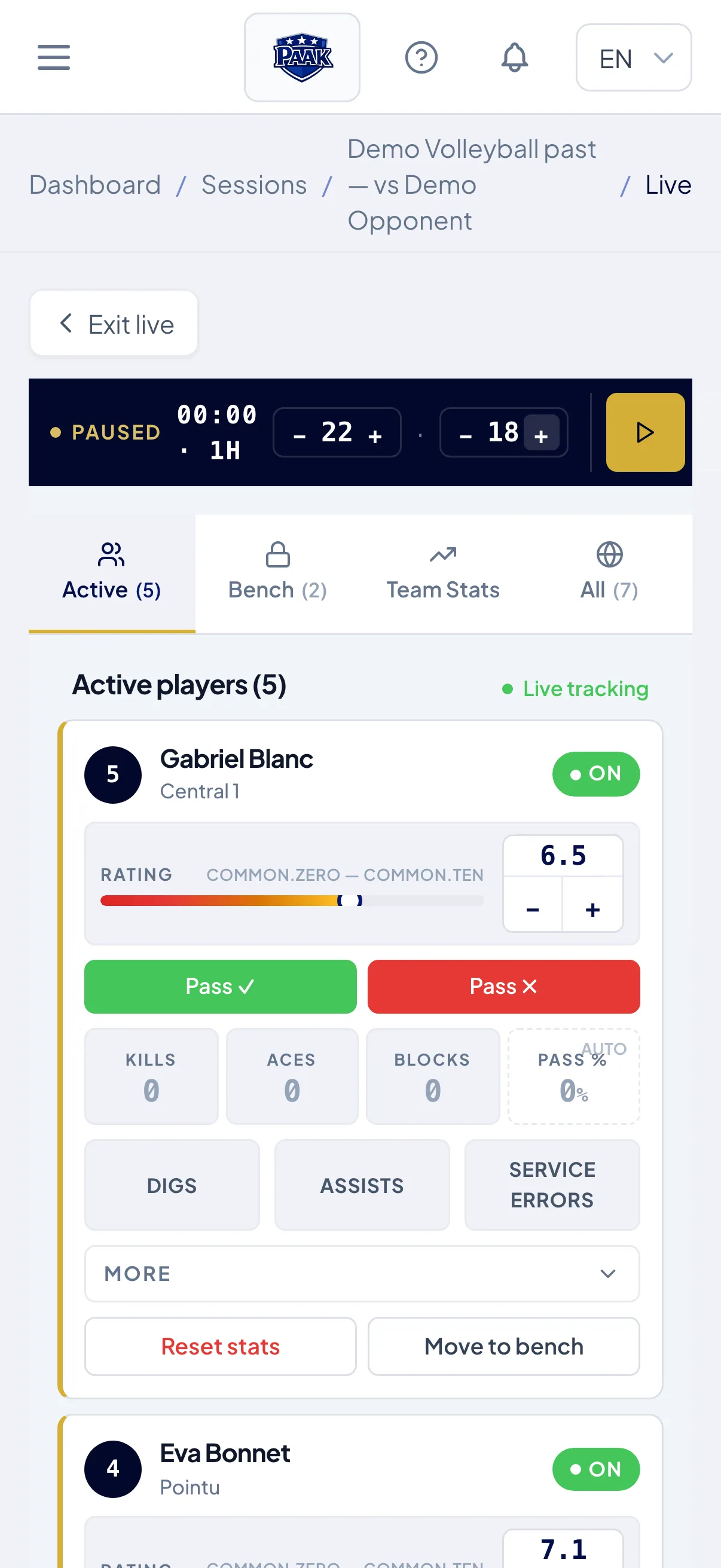
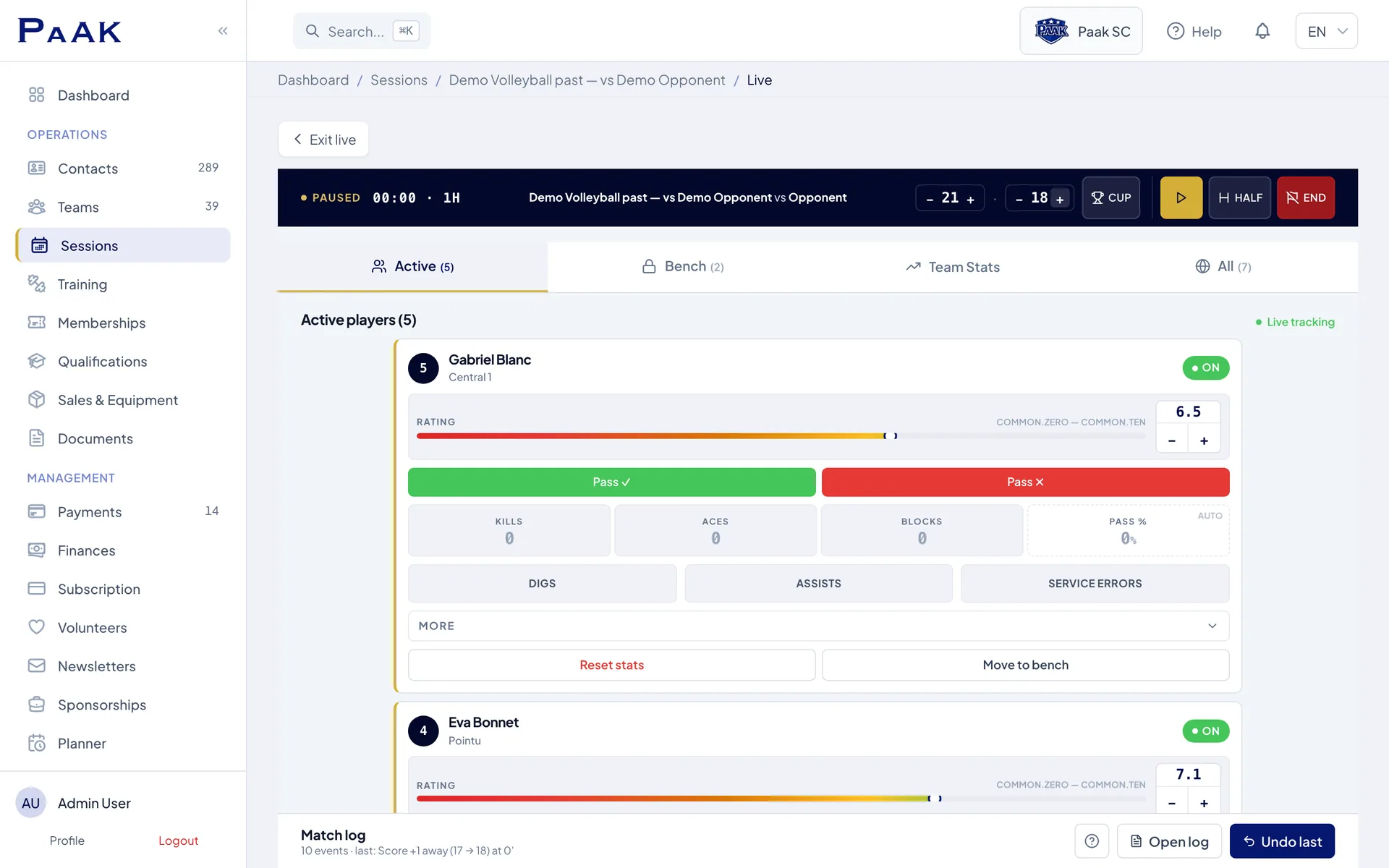
Kill, ace, block, dig: each action to the right player.
Multi-sport platforms treat volleyball as basketball without hoops or handball without the contact. It's neither. During the match, one click records an action and ties it to the player. After the match each player has a complete stat line with no re-entry. The live match tracker is part of Paak Pro.
- Kills, aces, winning blocks, digs, setting assists, service errors: recorded in one tap
- Automatic /10 rating: computed from weighted action impacts, adjustable by the coach before validation
- Sets to 25, 2-point margin: best of 5, fifth to 15, no match clock
A player profile that adapts to the position.
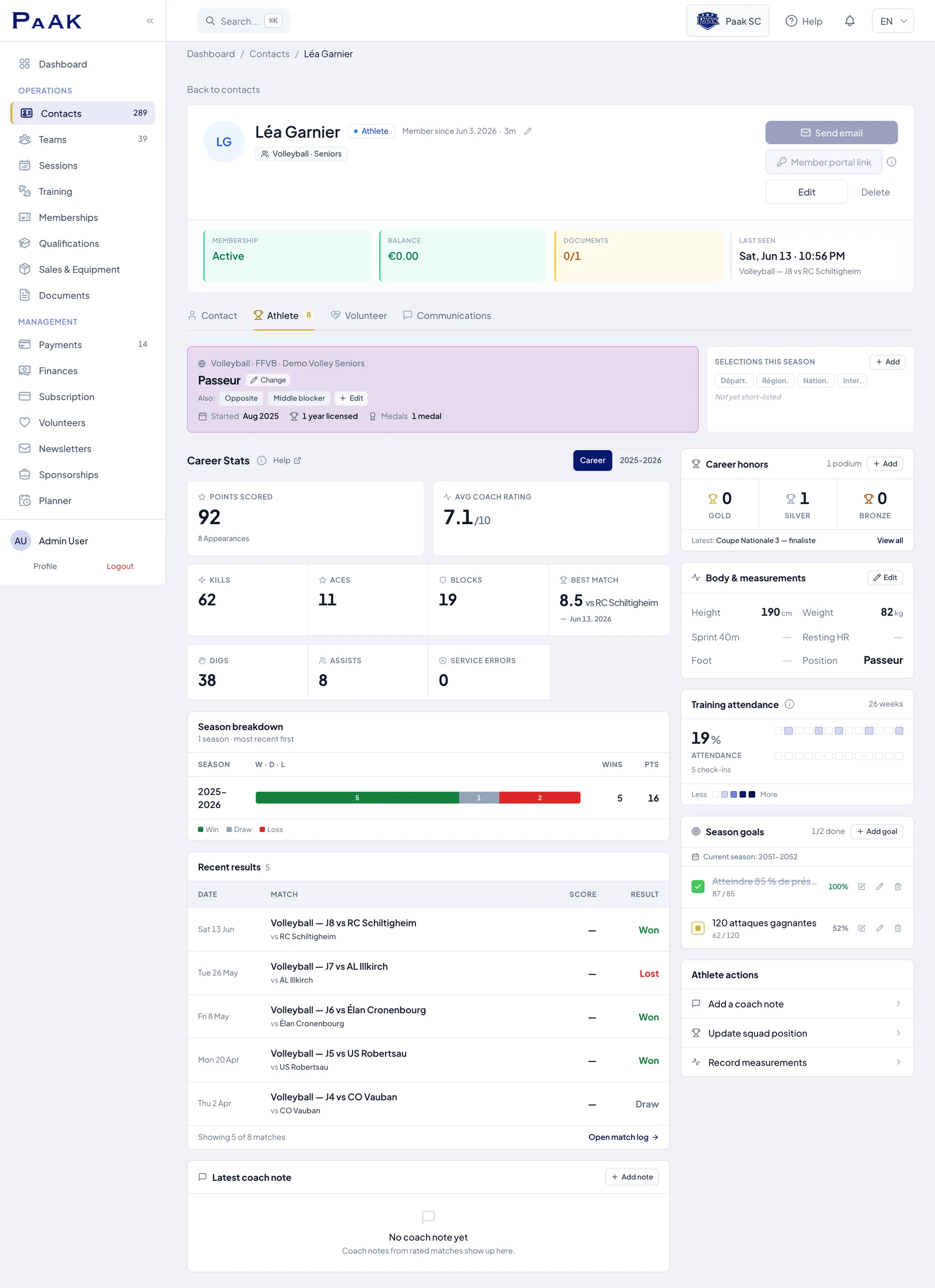
An outside hitter isn't measured on the same stats as a libero. The athlete profile surfaces an outside hitter's winning attacks, a libero's digs, a setter's assists. Every action in a match feeds the profile.
- Automatic metrics: kills, aces, blocks, digs per match, points scored (kills + aces + blocks) and kills per set across the season
- Preferred position, jersey number, libero status on the player profile
- History by position: performance as outside hitter vs libero, season by season
- Federation licence, age category (U13 to U20, seniors) and medical certificate on the same profile
Less admin, more volleyball.
While you are courtside, the club keeps running: members register online from your club’s public page, pay their fees and sign their waivers, and everything lands in your dashboard, with nothing to re-type.
Included from the free plan: public page and member portal on every tier.
- Online registration from your club’s public page, no more paper forms
- Fees by card or SEPA direct debit, in one or several instalments per your plans
- Waivers and image-rights consent signed online, timestamped
- A member portal with no account, no password: schedule, payments, documents
- Automatic reminders and follow-ups: fees, licences, certificates
- One-tap roll call, attendance tracked session after session
The score, in volleyball's own language.
No invented stats: exactly the events a volleyball coach needs to record. Each action tapped on the tracker feeds the player's profile.
The 7 positions of indoor volleyball.
Six players on court at any time, but seven distinct positions in a roster: the libero shuttles in and out of the back row. Each position has its typical stats, which Paak pre-filters.
Z4 Outside hitter
Attack and receive. Usually the primary scorer.
Z3 Middle blocker
Block and quick middle attack. Often substituted by the libero when rotating to the back row.
Z2 Opposite
Attacks from zone 2 and zone 1 back-row. Generally doesn't receive.
Z6 Setter
Distributes the offence; rarely attacks the ball.
Z5 Back left
Left-side reception and defense. Often an outside hitter rotated to the back row.
Z1 Back right
Reception and service. Often the opposite in rotation, or the setter.
L Libero
Defensive specialist in a different-coloured jersey. Enters the back row without counting against substitutions. Cannot serve (under FIVB rules), cannot attack above the net, cannot be team captain. Paak recognises the libero as a full-fledged position.
Paak complements your federation portal: no need to replace it.
French volleyball has roughly 140,000 FFVB licensees: very few pro clubs, many amateur clubs organised in regional and departmental leagues. Youth categories (FFVB nomenclature M11, M13, M15, M18, M21; equivalent to the U-prefix in international FIVB conventions) run in parallel with seniors. Most federations expose licence and ranking data via their portals; you keep that. Paak lives alongside and handles what those tools don't. Equivalents in other countries (FIVB confederations, US college, German DVV) follow the same pattern.
Stays your official reference
- Player, coach and referee licences
- League / championship entry
- Official federation match sheet
- Official appointments
What you gain on top
- Tiered fees by age category (youth → seniors) with family discounts
- Online payments (Mollie) for fees, camps, equipment
- Match log: 6v6 scoring, kills/aces/blocks/digs, stats by player and position
- Player profile season after season: averages, libero status, honours
- Child-protection compliance: tracking of staff background checks
- "League match" session type to separate championship from friendlies
French loi du 8 mars 2024, tracked for you.
The French law of 8 March 2024 makes club presidents personally liable for the honorabilité (background-check status) of every coach, official and adult volunteer in regular contact with minors: in volleyball, this covers the head coach, assistants, Smashy / mini-volley animators, line judges and table officials present at youth (M9 / M11 / M13 / M15 / M17 / M21) sessions. Paak makes that tenable for a volunteer-run club.
- Status per coach: valid / expiring soon / expired
- Automatic reminders 30, 14 and 7 days before each attestation expires: email to the coach and notification to the president
- CSV export in the ministry SI Honorabilité / FIJAISV column order, one click
- Federation licence (FFvolley), coaching/refereeing qualification and medical certificate on the same coach profile
Attendance at training, even offline.
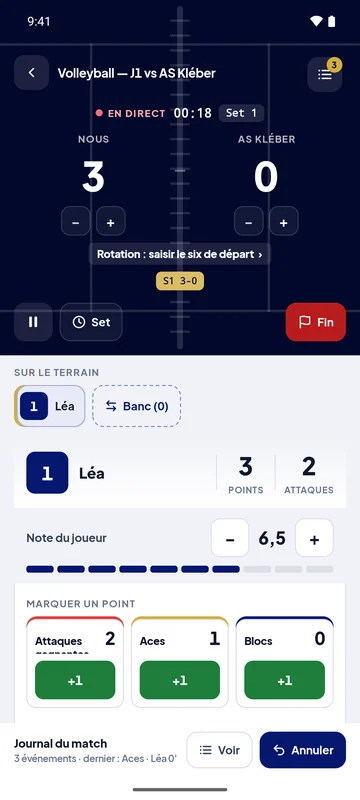
The Paak app for your coaches and club officers: offline attendance, a reminder before each session, the live match with Paak Pro. Included in every plan.

Your members get their own space, no account, no password.
A personal secure link in every club email: schedule and call-ups, dues payable online (“Pay everything” in one payment), medical certificate upload, progression, volunteering.
Simple, transparent pricing
Start free. Upgrade when your club grows. One price, for every club.
- Up to 100 members
- 3 admins, 1 sport, 3 groups
- Member management & CSV import
- Households, emergency contacts & family discounts
- 10 MB of file space
- Sessions & attendance with RSVP
- Collect membership fees online: 1.2% fee (capped at €2.50)
- Session plan on the session: minuted blocks, editable
- Club newsletter + member emails: 50 per month
- Emergency protocols & incidents
- Sponsorship (3 max)
- Staff safeguarding checks (legally required)
- EU-hosted data, built for GDPR
- Member portal for every member: no account, no password
- Public club page: your web presence, in your colors, with registration built in
- Everything in Free, plus:
- 500 members, 5 admins (+€3/seat/mo)
- 3 sports, 10 groups
- Automated payment reminders
- Club-branded emails
- Sponsorship management + sponsor benefits
- Email support
- Sales & equipment (passes, gear)
- Honorability: federation CSV export + auto reminders
- Club newsletter + member emails: 300/mo
- Automated season rollover
- Accounting: income & expense journal + CSV export
- Member documents (medical certificate): encrypted upload + review
- 500 MB of file space
- Printable session sheet + unlimited club-authored drills
- Public page: choose which sections show (fees, teams, venues…)
- 0% Paak fee on online collections
14-day free trial included
- Everything in Paak One, plus:
- Unlimited members
- 10 admin users (+€5/seat/mo)
- Unlimited sports & groups
- Advanced analytics & exports
- Live performance tracking
- Training analytics: planned vs delivered
- Sponsorship ROI & auto-renewal
- Priority support
- Advanced newsletter (rich editor, templates, analytics, 5,000/mo)
- Newsletter merge fields (12 variables)
- AGM financial report · budget · bank reconciliation · XLSX export
- 2 GB of file space
14-day free trial included
Prices shown are net (excl. VAT). VAT not applicable: service exported from Switzerland, reverse charge by the customer (art. 8 para. 1 LTVA).
Accepted payment methods
Frequently asked questions
Are there ready-made training sessions?
Yes. Pick an age group and a theme (serve and reception, setting and attack, block and defence, team play and rotations, physical preparation) and Paak builds a minuted session (warm-up, two blocks, a game, cool-down) from 30 drills taken from the OFSPO mobilesport practice booklets, J+S and the FIVB frameworks. They are exactly the same drills as in the Côté Coach volleyball guide: 8 themes and 4 age groups (U9, U13, U17, seniors), with mini-volley (low net, reduced court) for the youngest. Planning, editing and saving the session is free; printing the sheet is in Paak One.
Does Paak handle the specific format of volleyball (6v6, best-of-5 sets, rotations, libero)?
Yes. 6 players on court rotating clockwise, best-of-5 sets (first four sets to 25 with 2-point margin, fifth set to 15), and the libero position, a defensive specialist who cannot attack or serve under FIVB rules. Natively configured, not adapted on the fly from another sport.
Can we score a match live with volleyball-specific actions (kills, aces, blocks, digs)?
Yes. Live scoring records kills (winning attacks), aces (direct service points), blocks, digs (defensive saves), setting assists, and service errors. Statistics consolidate by player and by set.
Does Paak support federation licence tracking and league play?
Yes. Paak tracks federation licences (player, coach, referee) with expiry dates. For league matches, the Sessions + Rosters module handles match sheets per team and per competition level. There is no automatic sync with federation portals today; licences are entered once, then tracked inside Paak.
We're a departmental club, not Pro A. Is Paak right for our level?
Yes, and that's precisely the target. Amateur clubs at departmental and regional levels have neither a full SportEasy-equivalent nor professional-grade software. Paak is built for them. Pro-level clubs have their own internal tools.
Does Paak support beach volleyball or snow volleyball?
Not yet. Paak covers indoor 6v6 volleyball, the majority format in amateur clubs. Beach volleyball (2v2, different FIVB rules) and snow volleyball are not pre-configured. A club can adapt Paak via generic configurations if needed, but these formats are not our current focus.
Your volleyball club, connected in 30 seconds.
6v6 scoring, libero tracked, positions, federation licences: it's all ready. Free up to 100 members, no credit card.