BJJ is won by submission, not on points.
In Brazilian jiu-jitsu, points matter if the match goes to the buzzer. But the objective is the tap. Paak tracks the progression toward the submission: GI and NoGi, IBJJF position scoring, belts and stripes.
- GI and NoGi: two formats with their own grips and submissions, tracked separately
- IBJJF position scoring: takedown, sweep, pass, mount, back; the submission ends the fight
- Child-safeguarding compliance: federation licences, instructors tracked, reminders before expiry
Free up to 100 members. No credit card. 30-second setup.
Everything an academy runs, in one tool.
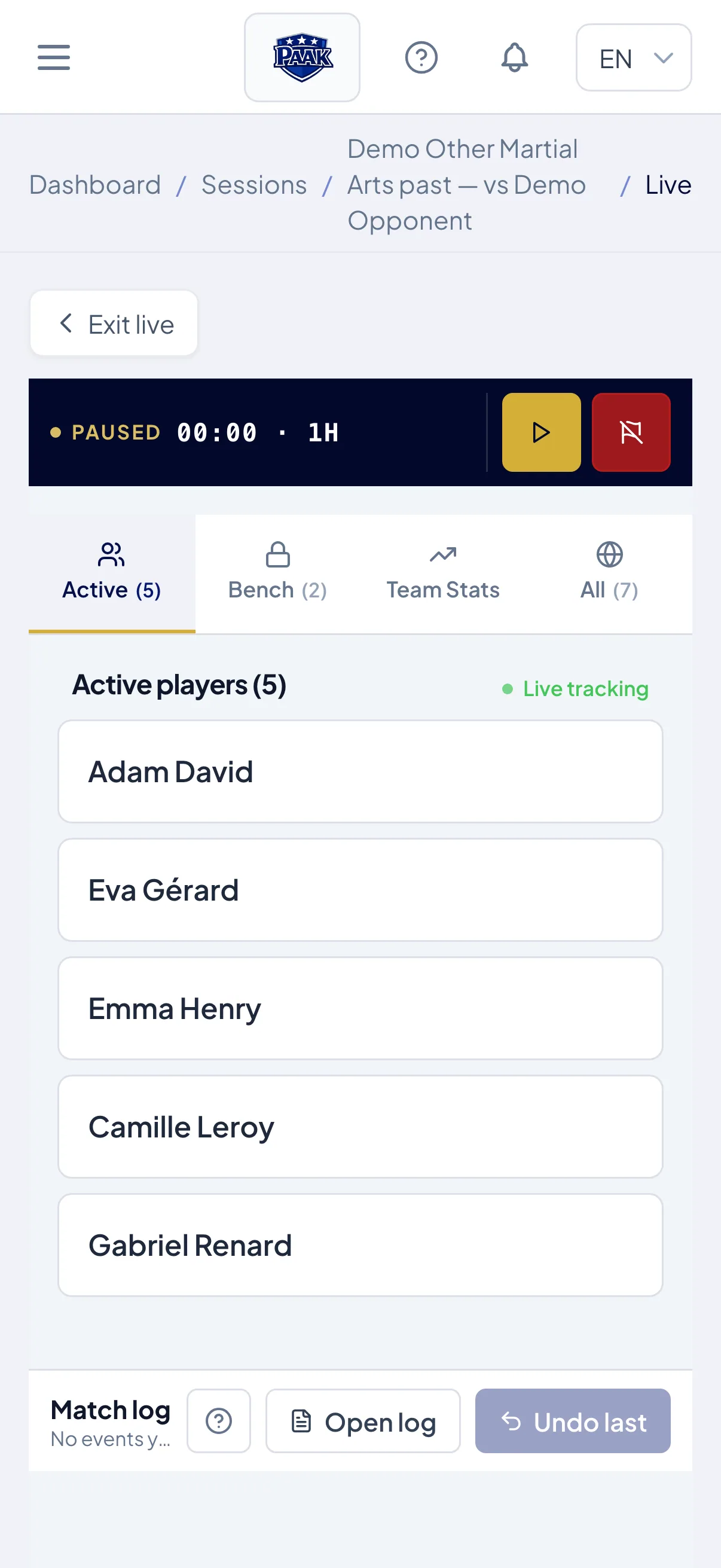
Position is scored, the submission decides.
Points make the match quantified, but the submission comes first. Paak records each position in real time: who took the back, passed the guard, swept, tapped. At the buzzer, points decide; before the buzzer, the tap decides. The live tracker is part of Paak Pro.
- IBJJF positions: takedown, sweep, knee on belly, guard pass, mount, back control
- Submission = instant win: the tap stops the fight, like ippon in judo
- GI or NoGi: the format is declared, the scoring adapts
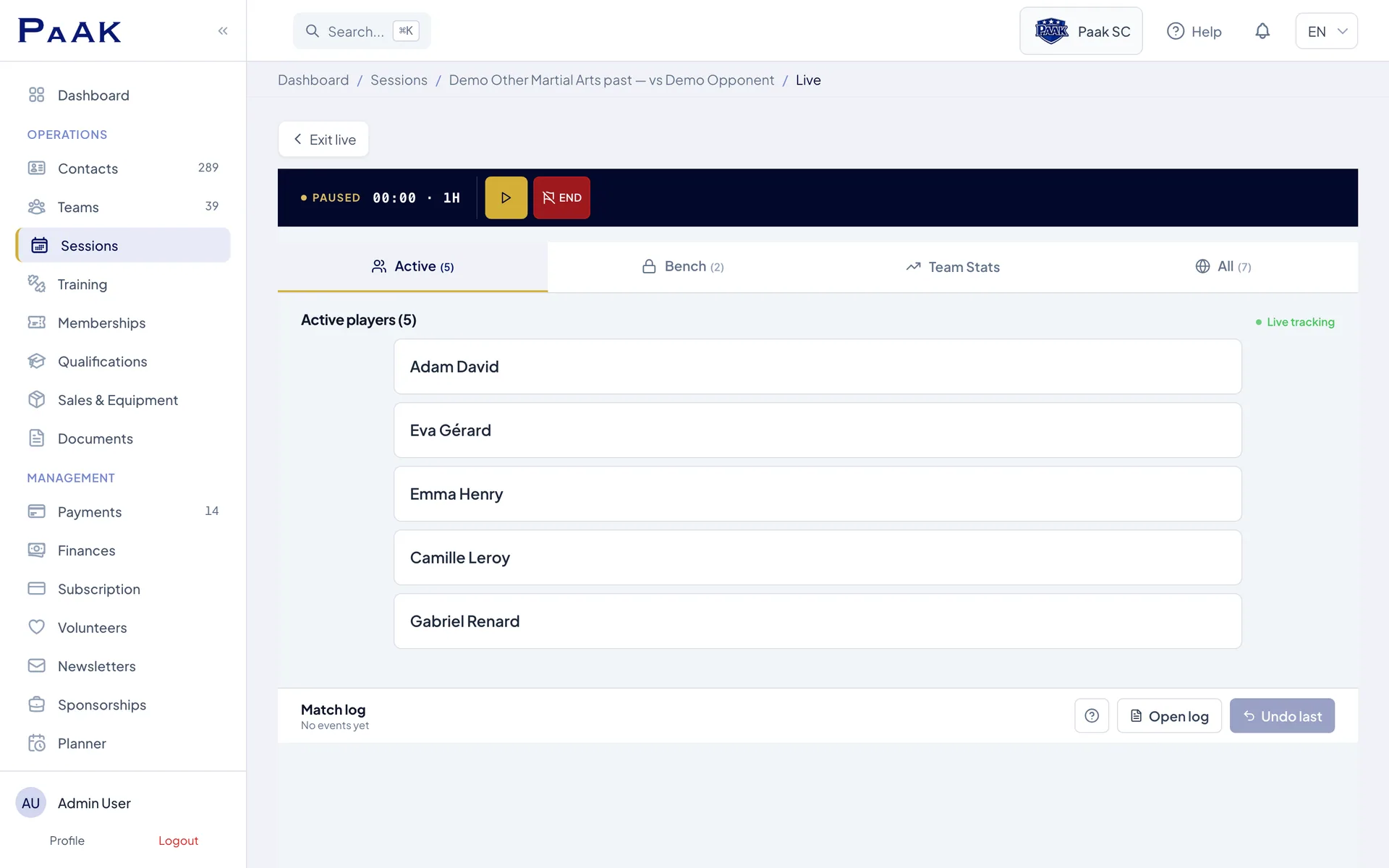
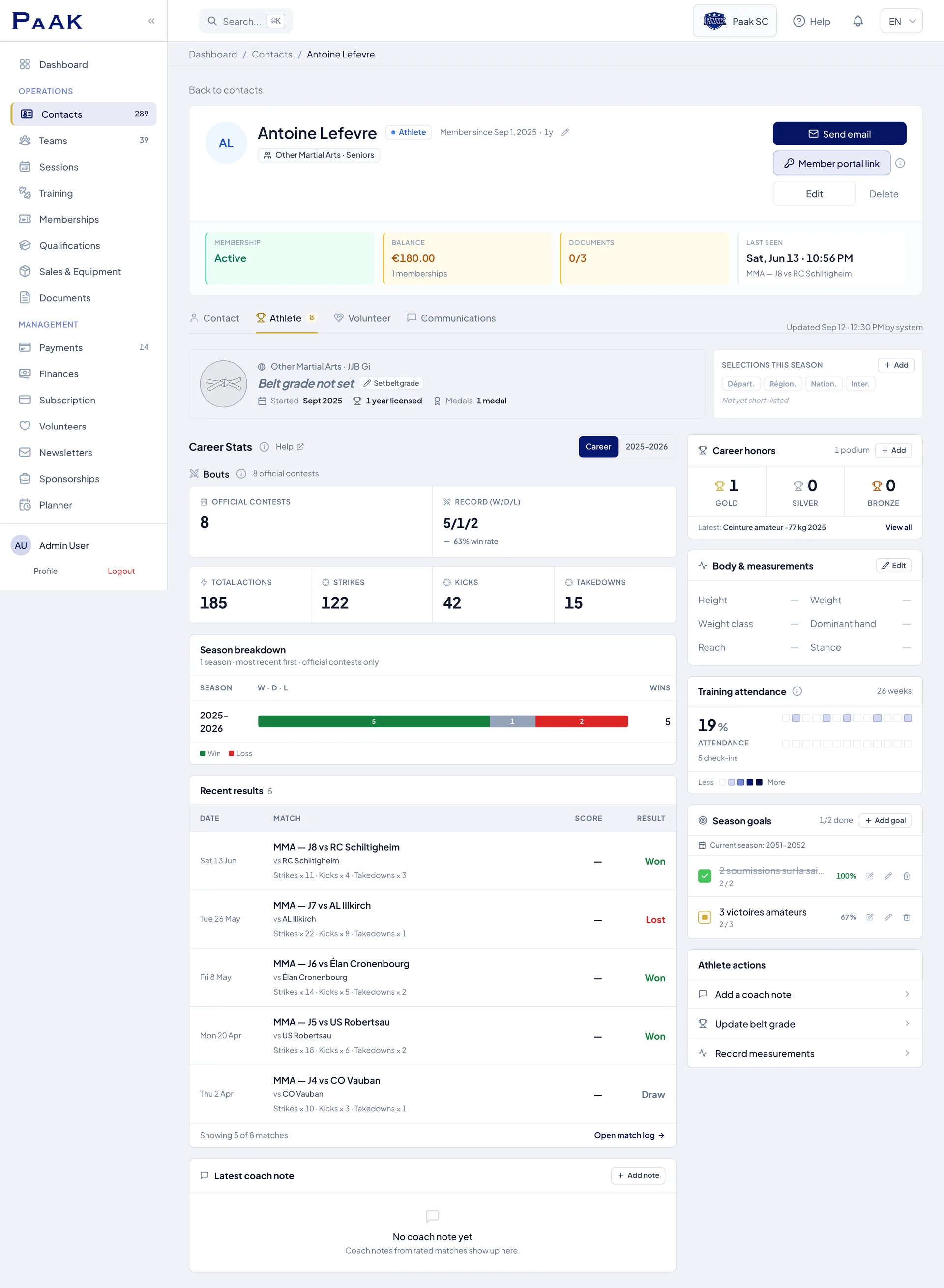
A profile that speaks BJJ: belt, stripes, formats.
Every roll feeds the practitioner's profile: belt and stripes, preferred format (GI / NoGi), weight category, and metrics computed automatically (submission rate, average point differential).
- Belt & stripes: adult (white → black, then red-and-black, red-and-white, red), 0-4 stripes
- GI vs NoGi: both formats tracked separately, preferred format shown
- Gradings: date, examiner, time in grade; the full history on the profile
Less admin, more jiu-jitsu.
While you are on the mats, the club keeps running: members register online from your club’s public page, pay their fees and sign their waivers, and everything lands in your dashboard, with nothing to re-type.
Included from the free plan: public page and member portal on every tier.
- Online registration from your club’s public page, no more paper forms
- Fees by card or SEPA direct debit, in one or several instalments per your plans
- Waivers and image-rights consent signed online, timestamped
- A member portal with no account, no password: schedule, payments, documents
- Automatic reminders and follow-ups: fees, licences, certificates
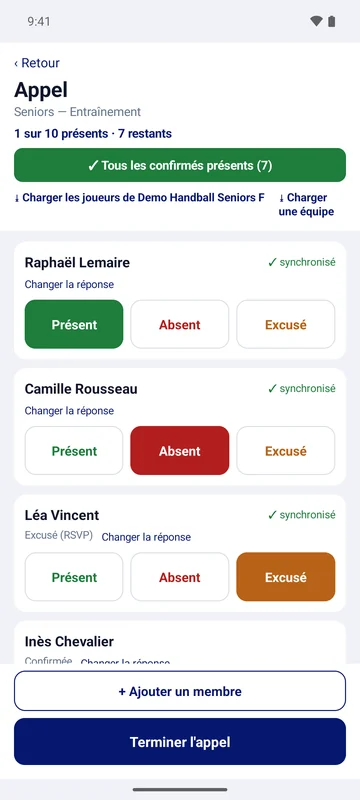
- One-tap roll call, attendance tracked session after session
Position points, in IBJJF terms.
No invented stats: exactly the positions and points of IBJJF competition. Every transition on a button, from the edge of the mat.
GI and NoGi: same root, two tactics.
BJJ is practised with or without the kimono. Same technical root (Gracie ground fighting, positions, submissions), but radically different tactics. A serious BJJ player does both. Paak tracks them separately.
GI: with kimono
- Heavy kimono, grips on the collar, sleeves and lapels
- Closed guard, collar choke, baseball choke, bow-and-arrow
- Slower, more tactical tempo
NoGi: without kimono
- Rash guard and shorts, no fabric grips
- Rear-naked choke, guillotine, leg locks, heel hooks
- Faster, more physical tempo
Belts & stripes: the adult grade, tracked on the profile.
Paak records each practitioner's adult belt, from white to red, with its stripes. Each belt accepts 0 to 4 stripes.
Stripes: 0 to 4 per belt, awarded by the instructor. Progression is slow: a brown-to-black promotion can take 10 years. The red-and-black (VII), red-and-white (VIII) then red (IX–X) belts reward a lifetime devoted to the art.
Who defines the list: for a French academy, Paak follows the IBJJF graduation system, and each belt shows who gives it: the club's black belt professor for the coloured belts and the black belt, the IBJJF for black belt degrees. The BJJ dan awarded by the France Judo dan commission (CSDGE) goes in a separate field. Your academy can adapt the list, free on every plan, without losing the official one.
Your federation, IBJJF + Paak: complementary, not competing.
Your national body handles licences; the IBJJF runs its own portal for international competition. You keep both. Paak handles everything they don't: the day-to-day life of the academy.
Stay your official reference
- Federal licences and insurance
- IBJJF registrations and certifications for international competition
- Brackets and results of official tournaments
What you gain on top
- Academy dues collected online (card or SEPA, in instalments), plus camps and opens
- The roll, live: IBJJF scoring, GI/NoGi, submission = win
- Practitioner profile: belt, stripes, formats, metrics
- Child-safeguarding: instructor checks tracked with reminders
- Multi-sections (BJJ + No-Gi + MMA + Luta Livre), communication, accounting
Instructor checks, tracked for you.
Anyone in regular contact with minors should be checked: the professor, assisting belts, kids coaches. Paak tracks each person's clearance date and alerts before it expires.
- Status per instructor: valid / expiring soon / expired
- Automatic reminders at 30, 14 and 7 days before expiry
- One-click CSV export in the format your authority expects
- Teaching qualifications and medical certificate on the same profile
Attendance at training, even offline.
The Paak app for your coaches and club officers: offline attendance, a reminder before each session, the live match with Paak Pro. Included in every plan.

Your members get their own space, no account, no password.
A personal secure link in every club email: schedule and call-ups, dues payable online (“Pay everything” in one payment), medical certificate upload, progression, volunteering.
Simple, transparent pricing
Start free. Upgrade when your club grows. One price, for every club.
- Up to 100 members
- 3 admins, 1 sport, 3 groups
- Member management & CSV import
- Households, emergency contacts & family discounts
- 10 MB of file space
- Sessions & attendance with RSVP
- Collect membership fees online: 1.2% fee (capped at €2.50)
- Session plan on the session: minuted blocks, editable
- Club newsletter + member emails: 50 per month
- Emergency protocols & incidents
- Sponsorship (3 max)
- Staff safeguarding checks (legally required)
- EU-hosted data, built for GDPR
- Member portal for every member: no account, no password
- Public club page: your web presence, in your colors, with registration built in
- Everything in Free, plus:
- 500 members, 5 admins (+€3/seat/mo)
- 3 sports, 10 groups
- Automated payment reminders
- Club-branded emails
- Sponsorship management + sponsor benefits
- Email support
- Sales & equipment (passes, gear)
- Honorability: federation CSV export + auto reminders
- Club newsletter + member emails: 300/mo
- Automated season rollover
- Accounting: income & expense journal + CSV export
- Member documents (medical certificate): encrypted upload + review
- 500 MB of file space
- Printable session sheet + unlimited club-authored drills
- Public page: choose which sections show (fees, teams, venues…)
- 0% Paak fee on online collections
14-day free trial included
- Everything in Paak One, plus:
- Unlimited members
- 10 admin users (+€5/seat/mo)
- Unlimited sports & groups
- Advanced analytics & exports
- Live performance tracking
- Training analytics: planned vs delivered
- Sponsorship ROI & auto-renewal
- Priority support
- Advanced newsletter (rich editor, templates, analytics, 5,000/mo)
- Newsletter merge fields (12 variables)
- AGM financial report · budget · bank reconciliation · XLSX export
- 2 GB of file space
14-day free trial included
Prices shown are net (excl. VAT). VAT not applicable: service exported from Switzerland, reverse charge by the customer (art. 8 para. 1 LTVA).
Accepted payment methods
Frequently asked
We only do NoGi at our academy. Does Paak adapt?
Yes. You declare the default format when you create the club. GI stays available as an option if you add it occasionally.
Are IBJJF points pre-configured?
Yes: takedown 2, sweep 2, knee on belly 2, guard pass 3, mount 4, back control 4. The submission ends the fight (instant win). Paak computes the score at the buzzer or at the tap.
How does Paak break a tie when a match goes to the buzzer?
On IBJJF points first, then on advantages: a near-finished position that scores no point but breaks the tie. Paak records both; if the gap is still level, the referee decides.
Is it really free?
Yes, up to 100 members. Online payments included via Mollie. No credit card to sign up.
Your academy, connected in 30 seconds.
GI + NoGi, IBJJF scoring, belts and stripes, safeguarding: it's all ready. Free up to 100 members, no credit card.