SWISS SQUASH for the licence and the ranking
The season licence is ordered and renewed on My-Squash, and the Swiss Squash Ranking stays the official national list. Paak does not replace them: it runs what happens at the club.
Paak already handles your members, CHF dues (incl. TWINT) and teams. For a club under SWISS SQUASH, the real constraint is not a spreadsheet: it is a date. On 1 September, an unpaid season licence removes the player from the national ranking.
Free up to 100 members. Live in Switzerland · CHF + TWINT.
For a Swiss squash club, SWISS SQUASH keeps the season licence and the official ranking, Paak runs club life (members, dues in CHF, training sessions, live match scoring with Paak Pro, Sonderprivatauszug tracking for coaches) and your current files are imported in one go. The two complement each other: Paak does not replace the federation.
The season licence is ordered and renewed on My-Squash, and the Swiss Squash Ranking stays the official national list. Paak does not replace them: it runs what happens at the club.
Members, dues in CHF (incl. TWINT), training sessions and attendance, live match scoring with Paak Pro, Sonderprivatauszug tracking for coaches. On a computer and on your coaches' phones. Free up to 100 members.
Create my club for free →Imported in one go: Paak recognises the columns and you check the rows before the import. If you prefer, send us your list and we import it for you, free.
While you are on court, the club keeps running: members register online from your club’s public page, pay their fees and sign their waivers, and everything lands in your dashboard, with nothing to re-type.
Included from the free plan: public page and member portal on every tier.
«Ab dem 1. September erscheinen nur noch die Spieler:innen im Ranking, die ihre Lizenz 2025/2026 bezahlt haben.» (From 1 September, only the players who have paid their 2025/2026 licence still appear in the ranking.) SWISS SQUASH: licence renewal, squash.ch (notice for the 2025/2026 season)
This is not one more formality. The Swiss Squash Ranking is the official national ranking list, decisive for every tournament and interclub seeding. A member who falls out on 1 September starts the next seeding further back, when the only failure was administrative.
Paak does not pay the licence: it is ordered and renewed on My-Squash, the federation's own platform, payable by credit card. Paak takes the half that belongs to the club: an up-to-date member list, a season that ends on a date you choose, alerts before it does, and dues payable online.
What Paak does, precisely: memberships are anchored to a season; the club is alerted automatically 30, 14 and 7 days before a membership ends; unpaid dues trigger an automatic email reminder (Paak One and above) into the member portal, where online payment works on every plan. What Paak does not do: no synchronisation with My-Squash. No public API was found on the SWISS SQUASH side: we will not claim a connector that does not exist.
Under its full name Schweizerischer SQUASH Verband (SWISS SQUASH) / Fédération Suisse de Squash / Federazione Svizzera di Squash, the federation is a Verein under ZGB Art. 60–79, in existence since 1973 and for unlimited duration. Its statutes (Art. 3) name it the competent Swiss federation in all matters relating to squash; it is affiliated to the World Squash Federation and the European Squash Federation, and is a Swiss Olympic member. Office in Langnau am Albis. Three regional associations sit between the clubs and the national body: Zürich Squash, Squash Romandie, Bern Squash. The official channel is squash.ch, and it stays that way.
No public API was found on the SWISS SQUASH side, and no connector is reserved in Paak. The bridge between the two worlds stays manual: export, then file import. We would rather say so than sell an integration that does not exist.
Swiss squash does not have a single grid. The federation publishes two, one per competition, and the oldest category is not the same: U19 on one, U20 on the other. Quietly merging them produces exactly the kind of mistake a club office pays for in rejected entries, so we show both.
The Junioren-Schweizermeisterschaften grid, as the federation publishes it.
The federation's junior circuit, eight tournaments per season, with a different oldest category from the JSM.
The Masters categories above are those confirmed by the 2026 Masters selection; others may exist. Swiss squash writes M+45, not “O45”: that notation comes from another country and has no place on a Swiss entry form. The federation's national squads: elite, juniors and masters.
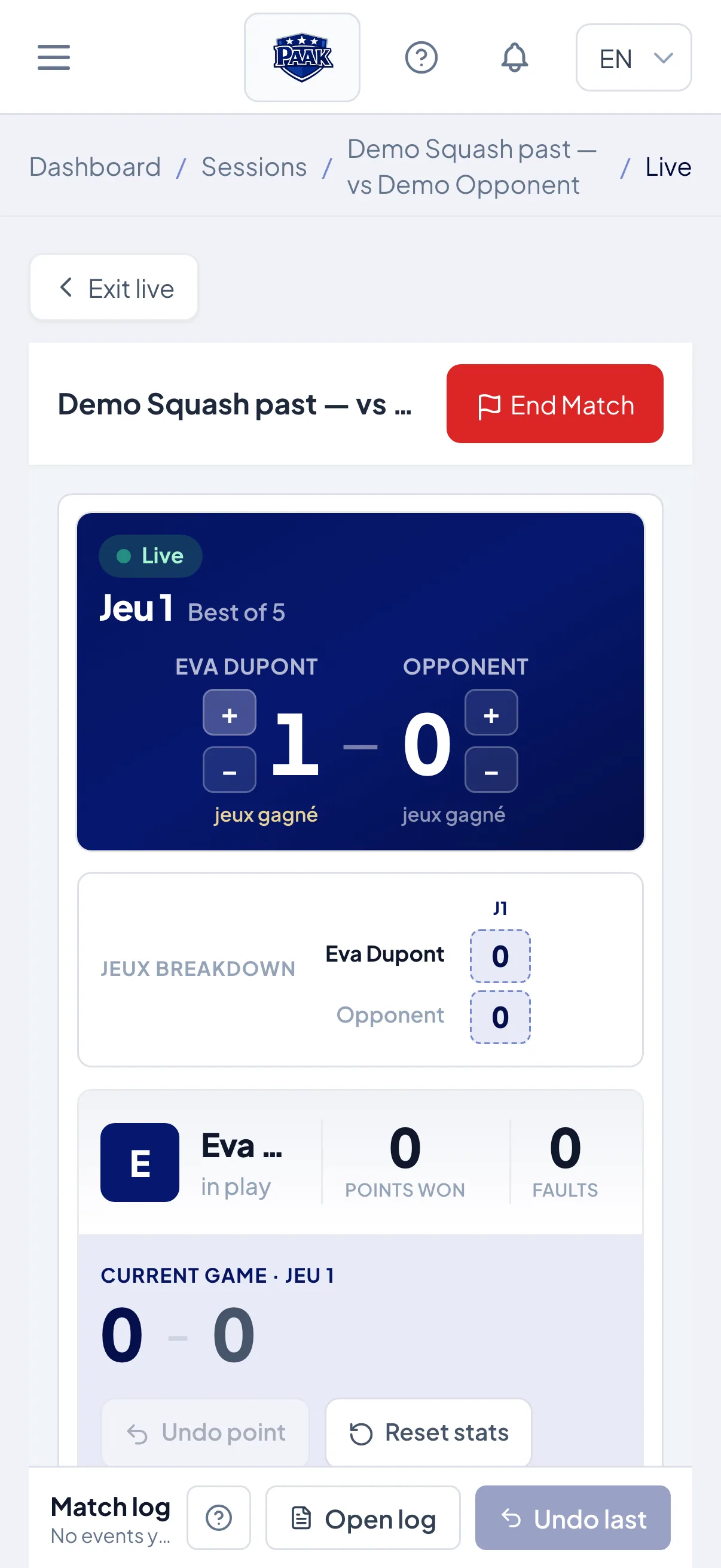
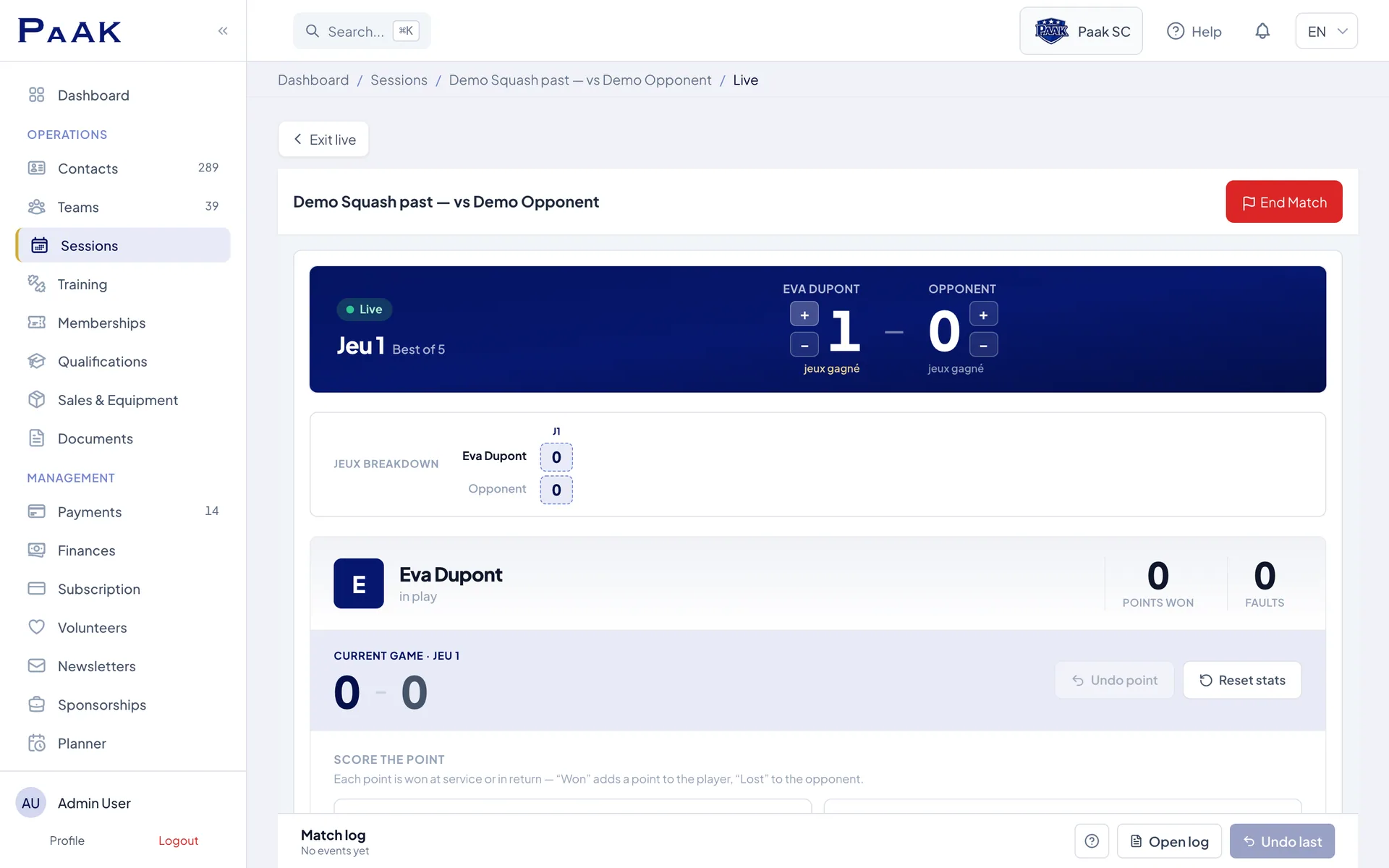
During the match, one tap adds each shot to the player's profile, from your phone, at the side of the court: four winning shots (winner, nick, drop shot, boast), the defensive lob and two errors (tin, unforced error). Every rally scores a point, games go to 11, and it is one against one. Live scoring is part of Paak Pro. Paak does not rate children: it is not offered to teams aged 12 and under.
You tap the player who wins the rally. Paak asks once who serves first, then knows who serves and from which box: the box alternates while the server keeps the serve, and the server chooses the box at the start of a game or when the serve changes hands.
A request for a let is answered in one tap: let (the rally is replayed, the score does not move), stroke (point to the player who asked) or no let (point to the other player). The match keeps the count of all three for each player.
When a game ends, the 2-minute break is counted down on screen, with the name of the player who serves first in the next game. Game point and match point are flagged, and at 10-all the board says a player must win by 2 points.
The format is chosen before the first point. The player's profile then keeps the strokes obtained, the strokes conceded and the lets.
| Statistic | Impact | Use |
|---|---|---|
| Winner | +2 | Clean winning shot, unreturnable |
| Nick (floor-wall join) | +2 | The ball dies in the join between floor and side wall: squash's signature |
| Drop shot | +1.5 | Soft shot close to the front wall, dead before the second bounce |
| Boast (side-wall winner) | +1.5 | Winner played off the side wall, a geometric attack |
| Lob | +0.5 | Defensive height recovery to neutralise an attack |
| Stroke (interference point) | +1 | Point awarded on interference, a signal of good position on the T |
| Tin (bottom-strip error) | −1.5 | Shot into the bottom strip of the front wall: rally lost automatically |
| Unforced error | −1.5 | Out of court, second bounce, ball not retrieved |
| Stroke conceded | −1 | Point given to the opponent on their request for a let |
| Let (rally replayed) | 0 | The rally is replayed on the player's request, the score does not move |
In a generic tool a nick is counted as an ordinary winner. But the nick (the ball that catches precisely the angle between floor and side wall and rolls out flat) is squash's signature. Its frequency in a player's profile says something precise: millimetre accuracy on attacking shots. That is exactly why Paak isolates it, and the nick share of winners is one of the profile's calculated metrics.
| Level | Effect |
|---|---|
| Conduct Warning | Nothing changes on the score. −0.5 pt on the rating |
| Conduct Stroke | One point to the opponent. −1.5 pt on the rating |
| Conduct Game | The game to the opponent; the player keeps the points already scored. −3 pts on the rating |
| Conduct Match | The match to the opponent. −5 pts on the rating |
Regulation singles court 9.75 m × 6.40 m: live scoring follows singles matches. The player profile holds the preferred variant (Squash 11 or Squash 57), playing hand, racket weight and the fastest shot measured by radar, and calculates winners-versus-errors ratio, nick share, tin error rate and attacking shot share.
Swiss squash is not a niche without an institutional frame: it is J+S-recognised, the federation holds its own subject-matter mandate, and squash is on the programme of the Los Angeles 2028 Games.
Squash has been part of Jugend+Sport since 1991, a stable federal frame for a club's junior section.
All children and young people between 5 and 20 are welcome in J+S courses and camps. Paak tracks attendance, call-ups and parental consent across that range.
Statutes Art. 2: SWISS SQUASH carries the Jugend+Sport subject-matter responsibility for squash and runs the interclub championship.
Squash makes its first Olympic appearance at the Los Angeles 2028 Games, from 15 to 24 July: the 141st IOC Session added it to the programme on 16 October 2023, for that edition. Two events, men's singles and women's singles, 16 players each.
Switzerland has no direct equivalent to the French law of 8 March 2024. The Swiss instrument is the Sonderprivatauszug: the special criminal-record extract (art. 371a of the penal code), which shows court-imposed activity bans and contact bans. It can only be ordered for an activity involving regular contact with minors, against a form signed by the club: a volunteer who does not supervise cannot obtain one. In a J+S junior section that means the coach and the assistants. Paak neither issues nor verifies the document: it tracks its status and warns before expiry.
Default cadence aligned with common Swiss sport-federation practice; expiry date editable per coach.
The Paak app for your coaches and club officers: offline attendance, a reminder before each session, the live match with Paak Pro. Included in every plan.

A personal secure link in every club email: schedule and call-ups, dues payable online (“Pay everything” in one payment), medical certificate upload, progression, volunteering.
Start free. Upgrade when your club grows.
14-day free trial included
Prices incl. Swiss VAT (8.1% MWST).
Accepted payment methods
Yes. On your group's session, pick an age group, a length (45, 60, 75 or 90 minutes) and one of five themes: movement and ghosting; length and solo practice; serve, return and length; short game and boast; volley and interception. Paak builds a timed session (warm-up, two main blocks, a conditioned game, cool-down) from 32 drills based on squash's published references: the WSF rules and training programmes cited as such. They are exactly the drills of the Côté Coach squash guide, free to read. Every drill carries the reminder that juniors wear certified protective eyewear, and several say which ball to pick for the group's level. Planning, editing and saving the session is free; printing the session sheet and club-made drills beyond 5 are in Paak One.
Yes, with Paak Pro. You tap the player who wins the rally: Paak counts games to 11 with a 2-point margin, works out who serves and from which box, and counts the points won on serve and on return. A request for a let is answered in one tap: let, stroke or no let, and the match keeps the count of all three for each player. The match is best of 5 games, or best of 3 if you choose it before the first point. Paak does not rate children: live scoring is not offered to teams aged 12 and under, and for ages 13 to 18 the coach first confirms a short reminder.
SWISS SQUASH states it plainly: from 1 September, only the players who have paid their season licence still appear in the ranking. And the Swiss Squash Ranking is the official national ranking list, decisive for every tournament and interclub seeding. So an administrative slip costs a ranking position. Paak does not pay the licence: it makes sure the club office does not walk into 1 September with open files.
No. The season licence is ordered and renewed on the federation's own platform, My-Squash (my.squash.ch), payable by credit card. That is the federal channel and it stays that way. No public API was found on the SWISS SQUASH side: Paak does not connect to it and does not claim to. Paak looks after the club's day-to-day, alongside.
The federation publishes two grids, and the oldest category is not the same in both: they must not be quietly merged. The Junior Swiss Championships (JSM) run U11 Mixed · U13 · U15 · U17 · U19. The SQUASH !T series (8 tournaments per season) runs U11 Mixed · U13 · U15 · U17 · U20. Masters carry a “+” prefix: M+45, M+55, W+55, M+60, M+65, M+70.
Yes, since 1991. J+S courses and camps are open to all children and young people between 5 and 20 years old. The SWISS SQUASH statutes (Art. 2) also state that the federation carries the Jugend+Sport subject-matter responsibility for squash and runs the interclub championship.
Yes. Paak knows the SWISS SQUASH Interclub format: four players for the men, three for the women, each match best of five games, the line-up in ranking order. Create the tie and line up your players match by match. Each match score is entered game by game, on every plan; a match can also be scored live with Paak Pro. Paak works out the tie score and, on a 2:2, says which team has the better draw and so takes the extra point (games, then points, then the result of the number ones). Each match counts in its players' records.
Yes. The SWISS SQUASH statutes (Art. 8) admit not only squash clubs but also squash centres, regional associations, passive members, individual members and honorary members. The Swiss membership model is mixed: Paak runs an association and a centre operation on the same platform.
Season, expiry alerts, CHF dues, ready-made sessions, Sonderprivatauszug: it is all ready. Free up to 100 members; live scoring is part of Paak Pro.