On Friday 13 June 2026, late in the day, tens of thousands of users around the world watched a tool they relied on stop responding. Not an outage. Not a cyberattack. A political decision.
On the orders of the US government, the company Anthropic had to suspend access to its two most advanced artificial-intelligence models — Fable 5 and Mythos 5 — for every non-US national. The directive applied to foreign nationals wherever they were, including on US soil, right down to the company’s own foreign employees. To comply, Anthropic ended up cutting access for everyone, overnight.
A service used daily by professionals across the world vanished in a matter of hours, by decision of a foreign state. That is exactly what digital sovereignty is about — and it is anything but an abstract debate.
What actually happened
The US government cited national security, pointing to the models’ ability to detect software vulnerabilities and the risk of their becoming “a cyberweapon in the wrong hands.” Anthropic publicly disputed the decision: the company argues its safety measures were extensively tested, notes that competing models have the same capabilities, and says the letter it received did not even spell out the precise concern. It is complying with the directive all the same, while seeking to have access restored.
The detail worth holding onto isn’t technical. It’s legal and geographic: the users affected had done nothing wrong, and the company itself disagreed. Neither the customers nor the provider had any say. A single jurisdiction decided, and the tool went dark for everyone else.
(For sources, the event was widely covered by the international press, notably Time and Al Jazeera.)
”Fine, but what’s this got to do with my club?”
The connection is direct, and it’s uncomfortable.
Your club probably isn’t running cutting-edge artificial intelligence. But it, too, depends on digital tools for vital functions: collecting membership fees, holding families’ contact details, communicating, managing registrations. Those tools are no longer a convenience — they have become infrastructure. And infrastructure, by definition, is something you count on to still be there tomorrow morning.
Ask yourself one question: if the provider of your management software, your payment solution, or your hosting were forced, overnight, to cut off access for foreign customers — what would happen to your club?
For most associations that rely on services hosted under a foreign jurisdiction, the honest answer is: I don’t know, and there’s nothing I could do about it. The membership file, the payment history, the data of minors — all of it would live elsewhere, under rules decided elsewhere.
This weekend’s episode is not some quirk confined to AI. It is a full-scale demonstration of a simple principle: what you don’t control can be taken away from you.
And the lever isn’t always a government
The most unsettling part is that this principle doesn’t even require a government decision. Sometimes the software vendor alone is enough.
Take the most ordinary example imaginable: Microsoft Office. Since 14 October 2025, Office 2016 and Office 2019 — those “buy once, own forever” versions — have stopped receiving any security updates. To stay protected, Microsoft now steers users toward a subscription, Microsoft 365.
And it gets starker. From 13 July 2026, Office 2019 for Mac drops into “reduced functionality mode”: Word, Excel, PowerPoint and Outlook will still open and print your files, but you’ll no longer be able to create, edit, or save them. In Excel, you won’t even be able to type a value into a cell. The cause is neither a crash nor an incompatibility: it’s a licence certificate that expires, and that the vendor has chosen not to renew.
Read that again. Software you bought, meant to work “forever,” becomes a read-only tool — not because it broke, but because its vendor decided so. To keep working as before, you’ll have to pay a subscription.
For a small club keeping its members, accounts and schedules in an Excel file, this is no distant abstraction. It is, potentially, being unable to edit the very document its whole organisation depends on — a decision made elsewhere, on a date it never chose.
(Sources: TidBITS and heise online; on the planned end of perpetual licences, Computerworld.)
Digital sovereignty, without the jargon
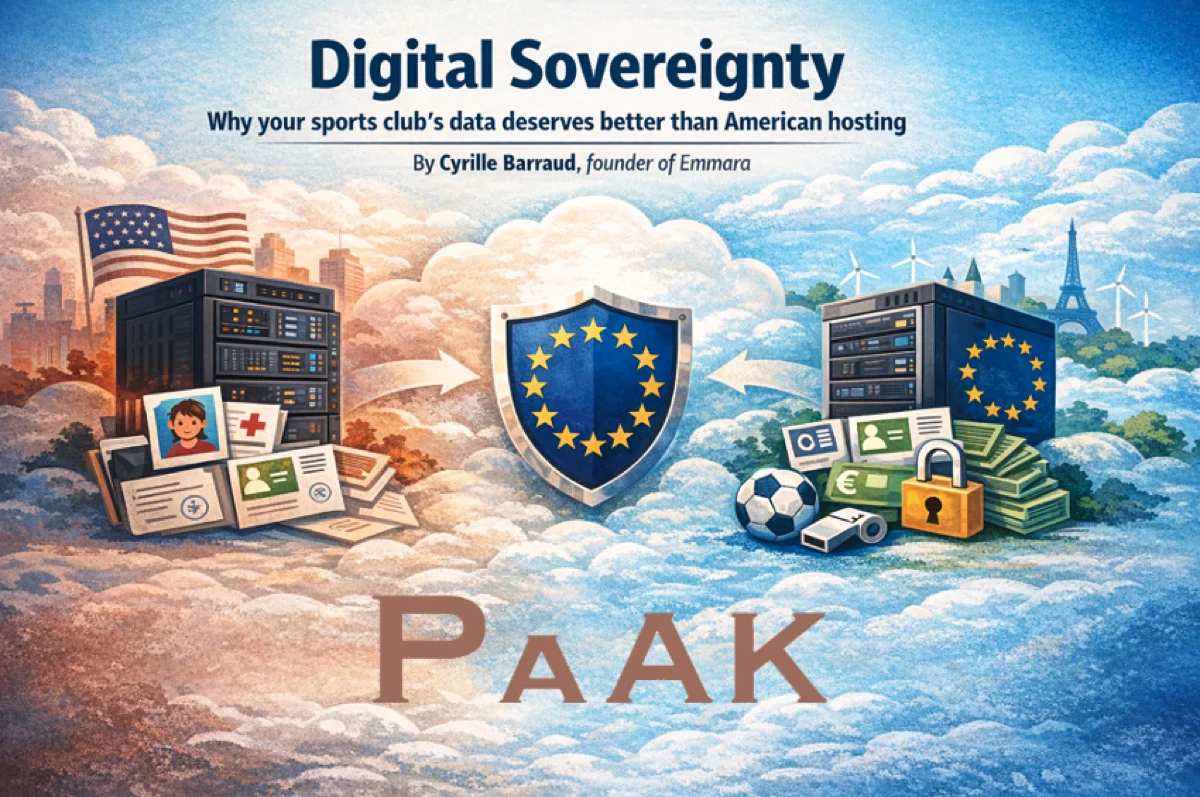
Digital sovereignty isn’t a political slogan. It’s a question of continuity and resilience: knowing where your data lives, under which laws, and who can decide to cut off access to it.
For a sports club, that boils down to three concrete questions:
- Where is my data hosted? On servers in Europe, subject to European law — or somewhere else?
- Who are my providers? European players, or companies whose home jurisdiction could, tomorrow, change the rules of the game?
- Am I protected by the GDPR end to end, or only “in theory”?
No tool in the world is entirely beyond the reach of any legal constraint — let’s be honest about that. But there is a vast difference between data that lives in Europe, with European providers, under European law… and data whose availability depends on the goodwill of a foreign government.
The choice we made for Paak
Paak didn’t wait for this weekend to make that choice. It is, in fact, the very reason the product exists.
- Your data is hosted in Europe, subject to the GDPR, not exposed to transfers outside the Union.
- Our essential building blocks are European: payments run through Mollie (Netherlands), authentication through Hanko (Germany), audience measurement through Matomo — self-hosted, without tracking your members for a third party’s benefit.
- Less admin, more sport: sovereignty must never be paid for in complexity. For you, it stays a simple piece of software — the difference plays out in the infrastructure, not in your day-to-day.
We don’t claim to be beyond every constraint. We simply say that a sports club, handling membership fees and the data of families and minors, deserves to have that information live close to home, under laws that protect it — rather than at the mercy of a decision made thousands of kilometres away.
The real lesson of the weekend
What happened to cutting-edge AI models — and what awaits old Office software next month — follows the same logic. The technology wasn’t the problem: governance and control were. A tool whose hosting, jurisdiction and access terms you don’t control can have its rules changed without ever asking your opinion — whether the lever is a state or a vendor.
To dig deeper, read also why digital sovereignty matters for sports clubs and what sets Paak apart.
Your club deserves tools it can count on — not just today, but the Monday after. Discover Paak — hosted in Europe, free for up to 100 members.
Less admin. More sport.