I spent over a decade in tech before coming back to the world of grassroots sports. And when I came back, I found club presidents managing 300 members with the same tools my grandmother used for her household accounts: a folder, a pen, and (because progress) an Excel spreadsheet.
This is not a judgment. It is an observation. And above all, it is an enormous opportunity.
Why 2026 is the year for club digitalization
Not because it is trendy. Not because some consultant said so in a webinar. Because three forces are converging at once.
Volunteer burnout has reached a tipping point. Studies across France, Germany, and the UK consistently show that volunteer administrators in sports clubs spend 8 to 15 hours per month on administrative tasks. That is two full working days, unpaid, every month. The consequence: volunteers quit. Clubs lose institutional knowledge. The cycle repeats.
Regulatory pressure is real. Across Europe, legislation increasingly requires clubs to verify the background of anyone working with children, and data protection enforcement has shifted from guidance to action. Clubs hold sensitive data: children’s personal details, medical certificates, bank information. If that data circulates in unprotected spreadsheets shared by email, the club’s leadership is personally liable.
Members expect more. The parent signing up their child for football in 2026 uses online banking, books holidays on an app, and orders groceries from their phone. When you hand them a PDF form to print, fill in by hand, scan, and email back, you have already lost them.
In short, digitalisation is no longer a luxury. It is institutional survival.
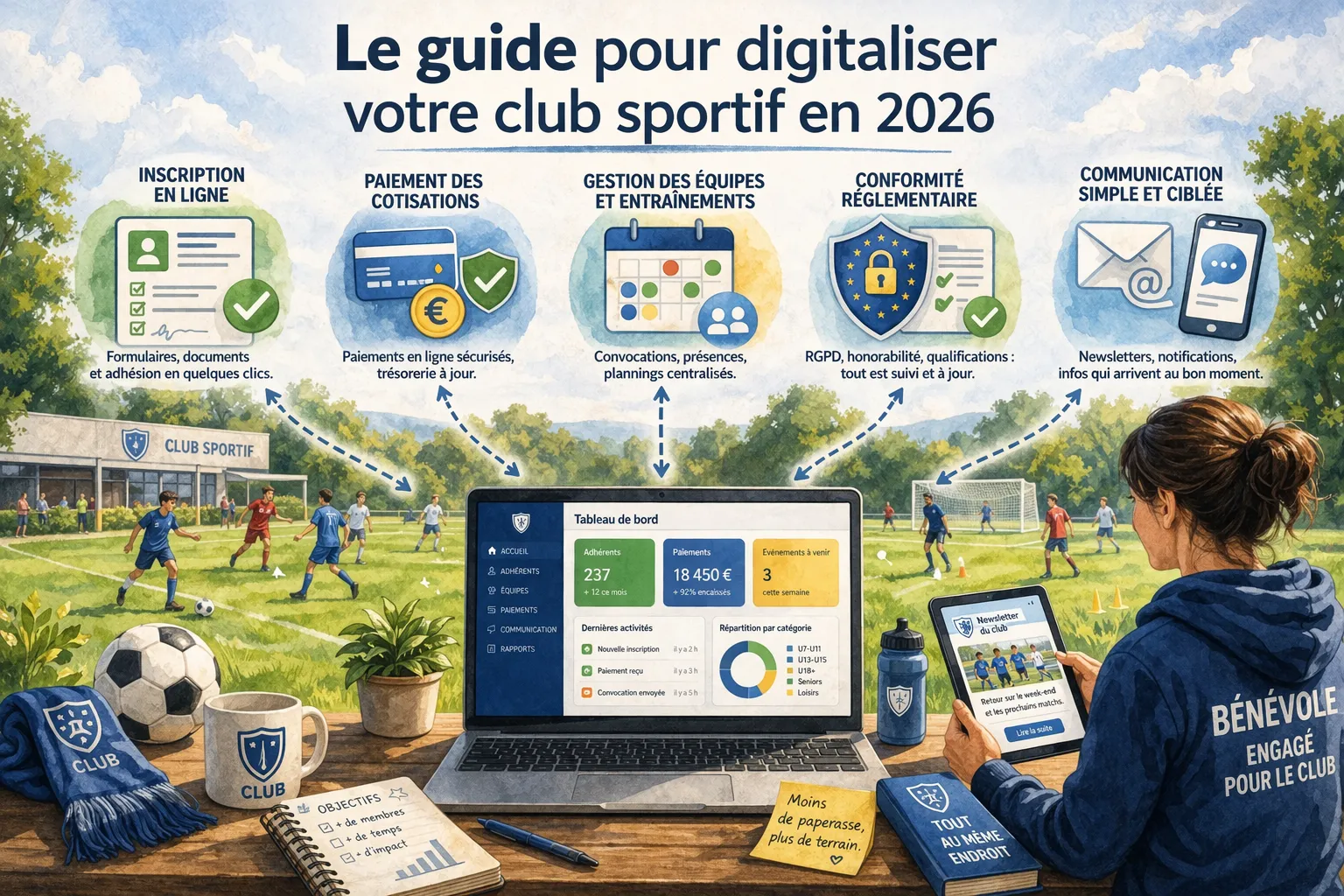
Step 1: Online registration and membership
This is where it starts. And it is often the easiest win.
The current reality
Most clubs still use paper registration forms, or at best, a PDF download. The secretary manually transcribes each form into a spreadsheet. Field by field. For 150 registrations every September.
Nobody wants to be the secretary.
What digitalisation changes
An online registration form does three things that paper never will:
It creates the member record automatically. No retyping. The member fills in their details, selects their team, chooses their membership type, and the system creates their file instantly.
It collects consent properly. Privacy policy acceptance, media consent for minors’ photographs, terms and conditions: all timestamped and archived. When the regulator comes knocking, your records are clean.
It triggers payment. The member can pay their subscription fee immediately, by card, bank transfer, or iDEAL. No more chasing cheques. No more reminder emails. The money arrives in the club’s account.
What this looks like in practice
You need a tool that gives you a shareable registration link: something you can put on your website, send via WhatsApp to parents, or print as a QR code in the clubhouse. The member clicks, fills in, pays, and it is done.
This is exactly what we built at Paak: a public club page in your colours, with a 5-step registration form and integrated Mollie payments. One link. Three minutes. Done.
Step 2: Subscription fees and payments
Money. The nerve of every club, and the first source of stress for volunteer treasurers.
The manual payment trap
The pattern is always the same. The club sends a reminder email. Some pay by cheque (which sits in a sports bag for three weeks). Others promise a bank transfer. A few disappear until the next training session. The treasurer follows up. And follows up again.
In our experience, subscription collection rarely reaches 100% before December, for a season that started in September. Three months of floating cash flow, manual chasing, wasted energy.
Online payment changes everything
When you offer online payment at the point of registration, two things happen:
Immediate collection rates jump above 70%. Members pay when they sign up, when motivation is highest. No chasing required.
The treasurer recovers 5 to 10 hours per month. Real, measurable time that can be spent preparing budgets or applying for grants instead.
What about the cost?
Every treasurer asks this. “Transaction fees on online payments are expensive.”
Let us be precise (April 2026 Mollie rates). A SEPA direct debit costs €0.35 per transaction, roughly 0.18% on a €200 cotisation. A payment by Cartes Bancaires (the common French card) costs 1.20% + €0.25, around 1.33% on that same €200. Add Paak’s commission: 1.2% capped at €2.50 on the free plan, 0% from Paak One (August 2026 schedule). Compare that to the cost of a lost cheque, a manual reminder, or an unpaid subscription that is never recovered.
Online payment is not a cost. It is an investment with a return measured in hours and euros recovered.
Step 3: Team management and training sessions
A club is not just a list of members. It is teams, schedules, coaches, venues, and match-day logistics.
The WhatsApp chaos
Raise your hand if your club runs on 12 WhatsApp groups: one per team, one for the committee, one for “general info” that nobody reads, and one called “URGENT MATCH SUNDAY” created at 10pm on a Friday.
This is not management. It is noise.
What a structured tool enables
Automated call-ups. The coach selects players. The system sends an email with date, time, venue, and a one-click RSVP link. No more “did you see the message in the group?”
Attendance tracking. Who comes to training? Who is regularly absent? This data is invaluable for coaches, and impossible to reconstruct from WhatsApp message history.
A centralised calendar. Slots, venues, pitches: all in one place, visible to all staff. No more scheduling conflicts discovered on Saturday morning.
Step 4: Regulatory compliance
Nobody enjoys this topic. But it is the one that can cost the most.
What the law requires in 2026
Data protection (GDPR). Privacy policy. Record of processing activities. Explicit consent for minors (collected from legal guardians). Limited retention periods. Right of access and deletion. This is not optional: it is European law, applicable since 2018, and increasingly enforced.
Safeguarding. Across Europe, legislation increasingly requires clubs to verify the background of anyone working regularly with children. In France, the law of 8 March 2024 mandates systematic checks. In Germany, an extended Führungszeugnis is required. In Switzerland, a Strafregisterauszug. The specifics vary; the principle does not.
Financial accountability. For clubs receiving public grants, a minimum level of financial traceability is expected. The famous Excel file with no audit trail does not qualify.
How digitalisation helps
A well-designed tool integrates these obligations into its normal operation. GDPR consent is collected at registration. Coaching qualifications are tracked with expiry alerts. Payments are recorded with a full audit trail.
You do not need to become a lawyer. You need a tool that has built the law into its design.
Step 5: Member communication
A club that does not communicate loses members. But a club that communicates badly (waves of untargeted emails, late-night WhatsApp messages, notices pinned to a changing room wall) is not much better.
The underrated club newsletter
A monthly newsletter, even a short one, works wonders for cohesion. Weekend results, upcoming events, a word from the president, a photo of the junior team. Five minutes of reading that remind members why they joined.
With an integrated newsletter tool, the club can send a professional email, branded with its colours and logo, without knowing any HTML. Opens and clicks are tracked. Bounces are handled automatically.
Targeted communications
Rather than emailing the entire club about a training session that only concerns the U15s, a structured system lets you target: by team, by age group, by role. Less noise, more impact.
Common objections (and why they no longer hold)
“We cannot afford it”
Solutions start at €0. Paak, for example, is free for up to 3 users, enough for a small club to test the tool without commitment. Paid plans start at €29/month. Less than a set of training bibs.
”Our volunteers are not tech-savvy”
If your volunteers can use WhatsApp and make an online bank transfer, they can use a modern management tool. The era of complicated software with endless menus is over.
”We have always done it this way”
The most honest objection. And the hardest to counter, because it is not rational. It is emotional.
But ask yourself: do your members want to keep doing it this way? The parents receiving a PDF to fill in by hand, the players who do not know if they are selected for Sunday, the treasurer spending Saturday evening chasing unpaid fees: does “this way” work for them?
Where to start
Do not try to do everything at once. Club digitalization is not a big bang: it is a series of small steps.
Month 1: Online registration. Set up a registration form with integrated payment. Share the link on your website and social media. Measure the immediate payment rate: you will be surprised.
Month 2: Member management. Centralise your data in a single tool. Import your Excel file (yes, most tools support this). Appoint a data steward.
Month 3: Communication. Send your first club newsletter. Set up automated call-ups for at least one team. Collect feedback.
Month 4 and beyond: Optimisation. Automate subscription reminders. Track coaching qualifications. Explore advanced features: performance analysis, equipment management, grant applications.
The bottom line
Hundreds of thousands of grassroots sports clubs across Europe. Millions of volunteers. Millions of children and adults who depend on these clubs to practise their sport, week after week.
These clubs deserve better than a spreadsheet and a WhatsApp group. Not because technology is an end in itself, but because every hour a volunteer does not spend on an administrative task is an hour they can spend on the pitch, with the athletes, doing what they signed up for.
Digitalization is not a technology question. It is a question of respect for the people who keep sport alive.
Paak is a management platform for sports clubs, sovereign and hosted in Europe. Online registration, subscriptions, communication, compliance: everything your club needs, in one tool. Try it free at paak.club