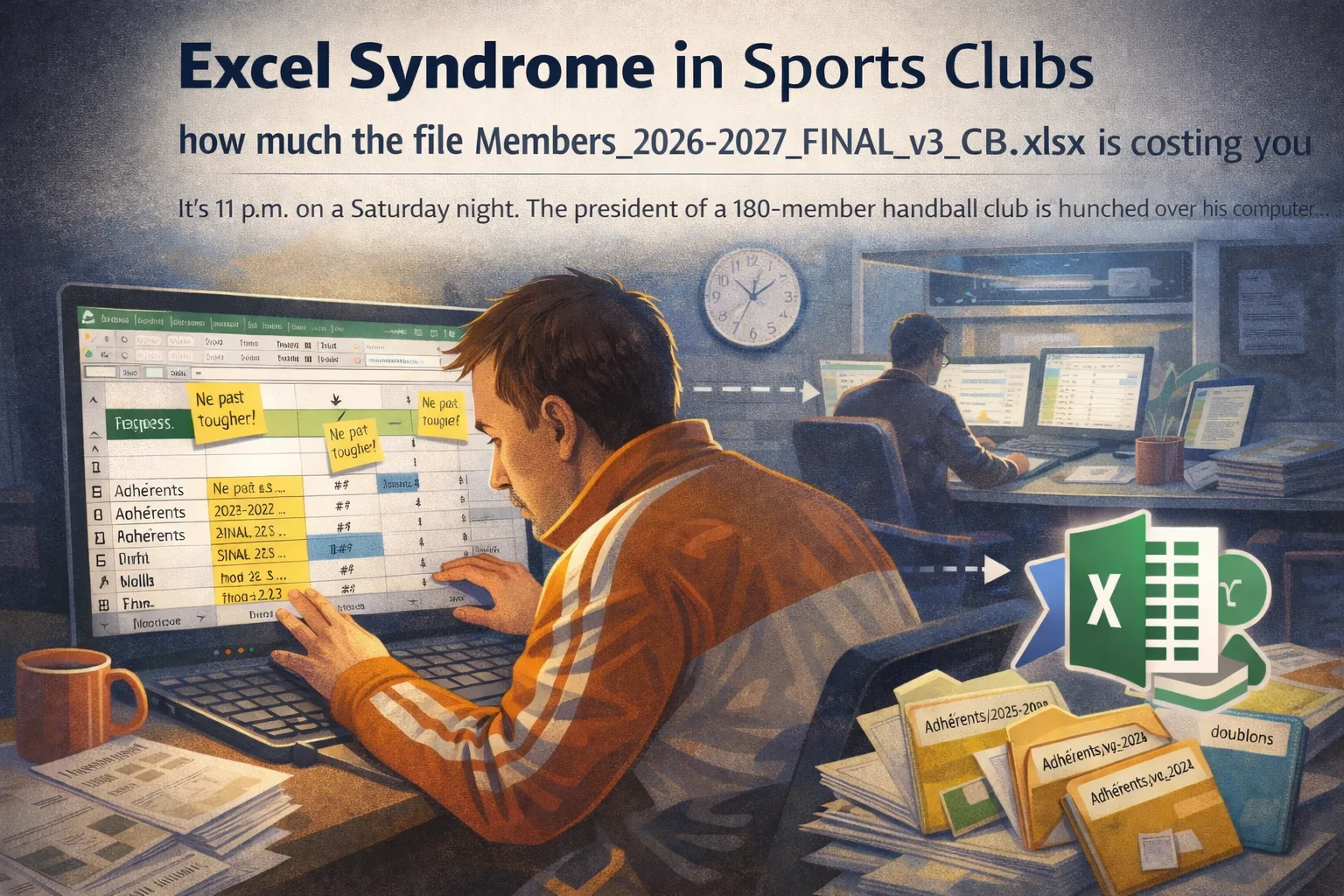
It’s 11pm on a Saturday night. The president of a 180-member handball club is hunched over his laptop. He’s updating an Excel file — the same one since 2019, with its 14 tabs, broken formulas, and bright yellow cells that “nobody must touch.” Tomorrow morning, the treasurer will open his own version of the file. A different version. With different numbers.
This isn’t a caricature. It’s the daily reality of thousands of sports clubs across Europe.
The spreadsheet: a tool hijacked from its purpose
Let’s be clear: Excel is excellent software. For calculations, budget modelling, one-off data analysis. But somewhere in the 2000s, sports clubs started using it for everything — member management, payment tracking, training schedules, parent communications.
The problem isn’t Excel. The problem is using a spreadsheet as a relational database, a CRM, a communication tool, and a payment system — all at once.
It’s like using a screwdriver to hammer in nails. It works, technically. But at what cost?
The 5 symptoms of “Spreadsheet Syndrome” in a club
1. Version multiplication
Does “Members_2025-2026_FINAL_v3_CB_edited.xlsx” ring a bell? When multiple people work on the same document, versions multiply. No one knows which is current. The treasurer has his copy. The secretary has hers. The coach has an extract emailed three weeks ago.
Result: inconsistencies, duplicates, lost information. And hours spent reconciling data that should have been centralised from the start.
2. No audit trail
Who changed the Martin family’s subscription fee? When? Why? In a spreadsheet, there’s no reliable history. No audit log. If an error creeps into a formula, it can go unnoticed for months — until the auditor (or the board) asks for answers.
For clubs that manage public grants and subsidies, this lack of traceability is a real risk.
3. Sensitive data running wild
Think for a moment about what that Excel file contains:
- Names, dates of birth (including minors)
- Home addresses and email addresses
- Parents’ phone numbers
- Medical certificates (sometimes scanned as attachments)
- Subscription amounts and payment histories
This file circulates by email. It’s stored on the president’s personal Google Drive. A copy sits on a USB stick in the clubhouse drawer.
Under GDPR, this is a violation. The data controller (the club) is required to guarantee the security and confidentiality of its members’ personal data. A spreadsheet shared by email meets none of these requirements.
4. Single-person dependency
In many clubs, one person “masters” the file. They know the formulas. They know which tabs not to touch. They understand the colour code invented in 2021.
When that person leaves the board, it’s a disaster. The new treasurer inherits an incomprehensible file, with no documentation, with VBA macros written by someone who’s no longer reachable. It’s the classic scenario of institutional memory loss.
5. Invisible time
This may be the most insidious symptom. Nobody times the hours spent on spreadsheets. Yet studies on the non-profit sector show that administrative tasks consume between 8 and 15 hours per month for volunteer leaders of medium-sized clubs.
Eight to fifteen hours. Per month. For volunteers who have a job, a family, and who’d rather spend their free time on sport — not on data entry.
The true cost of “free”
The knockout argument for Excel is always the same: “It’s free.”
But is it really?
Cost in volunteer time: If a club president spends 10 hours a month on administrative tasks that could be automated, and you value that time at minimum wage, that’s roughly €120 per month of “free” labour — or €1,400 per year.
Cost in errors: A wrongly recorded subscription, an overdue payment never chased, an expired medical certificate undetected. Every error has a cost: financial, organisational, sometimes legal.
Cost in turnover: Volunteer burnout is the leading cause of sports club decline. Research shows that the number of regular sports volunteers has dropped by 15% between 2010 and 2022. One of the primary reasons cited: administrative burden.
When a treasurer resigns because they’re tired of chasing unpaid subscriptions in a spreadsheet, the club loses far more than a volunteer. It loses months of recruitment, training, and continuity.
The spreadsheet isn’t free. It’s paid for in time, errors, and exhaustion.
What clubs that made the switch are doing
The good news: solutions exist. And they don’t cost what you might think.
Data centralisation
A dedicated management tool — whether club software or a SaaS platform — centralises all information in one place. No more multiple versions. No more files circulating by email. A single source of truth, accessible to authorised people, with configurable access rights.
Automation of repetitive tasks
Sending subscription reminders? Automatable. Checking medical certificate expiry? Automatable. Generating federation exports? Automatable. Sending training notifications? Automatable.
Every automated task is time returned to volunteers. Time they can spend on what truly matters: welcoming new members, running activities, building community.
Built-in compliance
A good tool handles GDPR for you: consent tracking, data retention periods, right of access and deletion. No need to be a lawyer. Compliance is built into the normal operation of the application.
Guaranteed continuity
When a board member steps down, their successor finds all the data, all the history, all the procedures. No mysterious files. No lost passwords. The handover takes minutes, not weeks.
So why haven’t clubs changed yet?
Three main reasons:
1. Habit. “We’ve always done it this way.” It’s obstacle number one in any transformation, whether in non-profits or businesses. The spreadsheet is familiar. Uncomfortable, but familiar.
2. Perceived cost. Many club leaders imagine digital tools cost hundreds of euros per month. That may have been true ten years ago. Today, solutions designed for clubs and associations start at a few dozen euros monthly — less than the cost of a set of jerseys.
3. Fear of change. Migrating from a spreadsheet to a structured tool seems daunting. But the reality is often simpler than expected. Most modern platforms offer Excel import. And once the data is migrated, the time savings are immediate.
The moment of truth
Your club probably manages between 50 and 500 members. Entire families. Minors. Medical data. Financial flows.
Ask yourself a simple question: would you run a business of this size with an Excel file shared by email?
The answer is no. Nobody would. And yet, that’s exactly what the majority of sports clubs do — out of habit, ignorance of alternatives, or resignation.
Europe’s sports movement represents millions of volunteers. These men and women give their time, their energy, their passion. The least we can do is give them tools that match their commitment.
The spreadsheet has served well. But in 2026, it’s time to move on.
Read more:
- Discover Paak’s features — member management, payments, compliance
- See pricing — starting at €0/month (Freemium)
- Why digital sovereignty matters for your club — our 100% European commitment
- Why CRM is no longer a luxury for sports clubs — centralise your data
Paak is a management platform for sports clubs, built to replace spreadsheets with a simple, secure, and 100% European tool. paak.club